Most budgets fail because they’re unrealistic; you can build a spending plan that fits your life by listing income and fixed expenses, prioritizing your goals, assigning realistic limits for variable spending, automating savings and bills, and reviewing progress regularly to adjust and stay on track.
Key Takeaways:
- Create a realistic plan by defining clear short- and long-term goals, prioritizing categories, and allocating money to needs, wants, and savings.
- Track actual spending and automate bills and savings to remove friction; use budgeting categories or an app and set limits for variable expenses.
- Review and adjust the plan monthly, keep a small buffer for surprises, and use simple behavioral tactics (round-up savings, scheduled rewards) to stick with it.

Understanding the Importance of a Spending Plan
You need a spending plan because it turns income into deliberate choices that match your goals. Apply the 50/30/20 split-50% needs, 30% wants, 20% savings/debt-and watch the math: on a $4,000 monthly income you allocate $2,000 to imperatives, $1,200 to flexible spending, and $800 to savings or debt reduction. That structure helps you prioritize high-interest debt, slash unnecessary subscriptions, and target milestones like building a $6,000 emergency fund in about eight months.
What is a Spending Plan?
A spending plan is a forward-looking map that assigns every dollar to a purpose-bills, goals, or discretionary spending-rather than vague limits. You set percentages or amounts based on actual income and timelines; for example, 30% housing, 10% transport, 20% savings, with a $500/month target for a down payment. By reconciling bank activity weekly, you turn assumptions into measurable adjustments and know exactly which expenses to trim to hit a two-year goal.
Why You Need One
You need a spending plan because shifting small amounts compounds into meaningful progress: cutting $50 per week frees $2,600 a year to accelerate debt repayment or investing, which at a 6% return becomes about $2,756 after one year. It also gives predictable buffers-maintaining a 3-6 month emergency fund helps you avoid high-interest credit for unexpected $1,200 expenses. With biweekly check-ins, you catch leaks and redeploy funds toward priorities faster.
Automate allocations on payday so saving isn’t optional, and earmark a fixed share of raises-say 10%-for long-term goals. Choose a payoff method: avalanche reduces interest costs fastest, snowball builds momentum through quick wins. For instance, paying an extra $200/month on a $10,000 card at 18% sharply shortens payoff time, while automating $300/month into a 4% account produces roughly $20,000 in five years, illustrating how steady actions build real results.
Key Factors to Consider
You should weigh income predictability, debt service, fixed versus variable costs, savings targets, and seasonal obligations when building a spending plan; for example, use the 50/30/20 rule-on $4,000 net that’s $2,000 needs, $1,200 wants, $800 savings/debt-or adjust if you have a $600 monthly student loan or high childcare costs. Track annual costs like insurance and aim for a 3-6 month emergency fund. The best plans align your monthly cash flow with specific goals and include a buffer for shocks.
- Income stability: full-time, freelance, side gigs
- Debt and interest rates: credit cards, student loans
- Fixed vs variable costs: rent/utilities vs groceries/dining
- Savings goals & timeline: emergency fund, down payment
- Seasonal and annual costs: taxes, insurance, holidays
Income Assessment
Calculate your net monthly income after taxes and benefits and average it over three months if earnings vary; for instance, gross $5,000 with ~20% taxes gives about $4,000 net-add predictable side income like $300/month but treat bonuses as discretionary. Use that dependable figure to cover necessarys first, then allocate remaining dollars to goals and flexible spending so your plan doesn’t rely on volatile receipts.
Expense Tracking
Track every transaction for 30 days and categorize them-groceries, transport, subscriptions, entertainment-to quantify habits; example: groceries $350, dining out $120, streaming $15. Use an app or simple spreadsheet, reconcile weekly, and flag recurring charges. The next paragraph gives practical tactics to streamline categories, automate rules, and set actionable monthly caps.
You should create 8-12 specific buckets (housing, utilities, groceries, transport, subscriptions, personal, savings, debt) and assign a monthly cap to each; if your variable spend is $600, cutting 10% frees $60 for savings. Automate with bank rules or tagging, export CSVs monthly to spot trends, cancel unused subscriptions, and run a 15-minute weekly review to keep the tracking habit sustainable.
Step-by-Step Guide to Creating Your Spending Plan
| Step-by-Step Guide | |
|---|---|
| Track 30 Days | Log every expense for 30 days using an app or spreadsheet; total each category to see true spending patterns. |
| Set Goals | Pick one short-term and one long-term goal with amounts and deadlines (e.g., $5,000 emergency fund in 12 months = $417/mo). |
| Categorize | Group expenses: fixed (rent, loans), variable (groceries, gas), discretionary (subscriptions, dining); assign target percentages. |
| Assign Limits | Set monthly caps per category (groceries $350, dining out $100) and flag overruns for review. |
| Automate & Review | Automate transfers to savings/debt, check progress weekly, and revise limits monthly based on actuals. |
Setting Financial Goals
Define specific S.M.A.R.T. goals: for example, save $5,000 for an emergency fund in 12 months by setting aside about $417 a month, or pay down $3,000 in credit card debt in 18 months by adding roughly $167 monthly plus interest. You should attach deadlines, milestones, and a tracking method so you can adjust contributions when income or expenses shift.
Categorizing Your Expenses
Split spending into fixed (rent, loan payments), variable (groceries, gas), and discretionary (subscriptions, dining out). Try a 50/30/20 starting split or tailor it-for instance, on $4,000 net you might assign $2,000 needs, $1,200 wants, $800 savings/debt-and tag transactions for 30 days to reveal where to trim.
When you tag transactions, create subcategories like groceries versus dining out so you see trade-offs; many people discover dining out is 2-3× grocery costs per meal. For irregular bills establish sinking funds by dividing the annual cost by 12 (a $600 annual policy = $50/month). If your take-home is $3,500, a sample allocation could be rent $1,050 (30%), groceries $350 (10%), transport $280 (8%), utilities $175 (5%), savings $700 (20%), debt $350 (10%), wants $595 (17%). Automate those transfers and revisit percentages after two months of tracked data.
Practical Tips for Sticking to Your Plan
Use small, specific actions: automate transfers, set one weekly spending cap, and audit receipts for 15-30 minutes each week; How to Create a Budget You’ll Actually Stick With outlines the 50/30/20 split and sinking funds. Quick tactics include:
- Automate at least $50-$200 monthly to savings
- Flag recurring charges and cancel unused subscriptions
- Set app alerts at 80% of category limits
Any plan that combines automation with short weekly check-ins becomes far easier to maintain.
Regularly Reviewing Your Plan
Check your budget weekly for the first month (15-30 minutes) to catch miscategorized transactions, then do a monthly 45-60 minute review to adjust allocations; if a category runs over 10% consistently, reassign funds or trim variable spending by concrete amounts (for example, cut dining from $250 to $150 to free $100). Set calendar reminders and reconcile statements within 3 days of paydays so you spot trends before they grow.
Adapting to Changes in Income or Expenses
If your income shifts, start by recalculating a baseline: use a 3-month average to smooth spikes, build an emergency buffer of 3-6 months of imperative expenses, and shift discretionary spending immediately-dropping discretionary by 10-20% can cover modest income dips. When a bill jumps (like a $50 utility increase), absorb it by trimming two $25 discretionary line items or reallocating from nonimperative sinking funds.
When you need deeper adjustments, act in phases: first, identify fixed imperatives (rent, utilities, insurance) and protect them; second, pause or reduce nonimperatives-freeze subscriptions, cut dining out, and delay nonurgent purchases. If you’re a freelancer facing 30% monthly volatility, set aside an “income smoothing” reserve equal to 20-30% of high-month earnings, and target repeatable savings like automating 10-20% of each payment into that reserve. Negotiate bills (phone, internet, insurance) for immediate savings, compare grocery prices and switch to lower-cost brands to save $50-150 monthly, and consider short-term side work to bridge a specific shortfall; tracking the math (how much each cut saves) makes trade-offs clear and manageable.

Utilizing Tools and Resources
You can speed progress by combining automation, simple rules like 50/30/20 or zero-based budgeting, and a monthly review that spots $5-$10 daily leaks. Automate transfers (for example, $100 biweekly to savings) and link accounts to see cash flow in one place. For a practical how-to, follow How to build a budget that actually works (and stick to it) for templates and step-by-step examples.
Budgeting Apps and Tools
You should test apps: YNAB forces a zero-based mindset and helps reallocate dollars, Mint aggregates accounts and tracks subscriptions, and EveryDollar simplifies a debt-snowball plan. Use auto-categorization, goal trackers, and real-time alerts; try one app for 30 days to see if it reduces untracked spending by at least 20% in your first month.
Worksheets and Templates
You’ll get quick wins with a customizable Google Sheet or Excel template: set fixed monthly bills, variable spending, and a column for sinking funds. Start with a 12-month template or a 50/30/20 sheet so you can project irregular costs and adjust allocations each month.
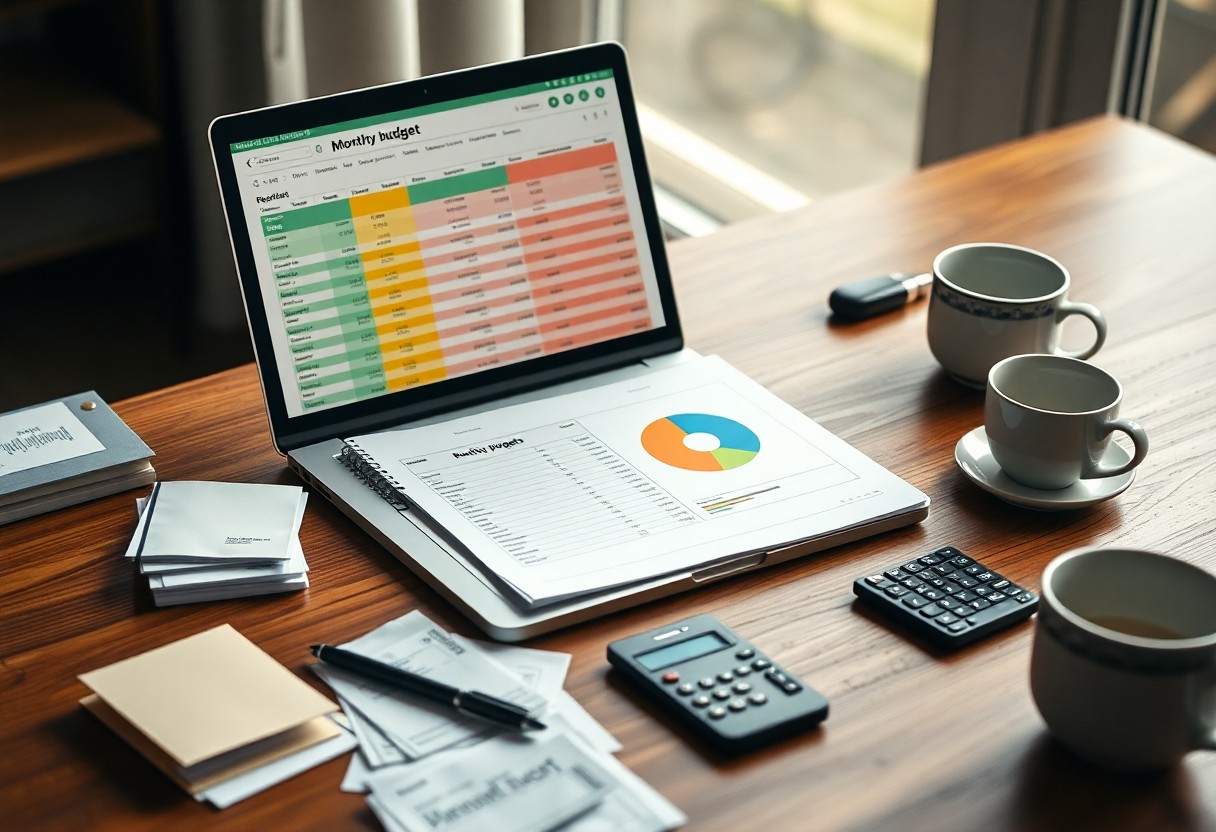
Build your worksheet with clear columns: Date, Category, Amount, Account, and Notes, and use SUM formulas to total categories. For irregular expenses, divide annual costs into monthly chunks (car registration $240 ÷ 12 = $20/month). Add conditional formatting to flag overspending and a simple IF formula to compare actual vs. planned (e.g., =IF(B2>C2,”Over”,”OK”)). Aim to log 60-90 days of transactions to set realistic category amounts, then update quarterly and increase sinking-fund allocations until you reach targets like a 3-6 month emergency cushion.
Overcoming Common Challenges
Dealing with Impulse Spending
When impulse hits, apply a 48-hour rule for non-crucials and set a dollar threshold (for example, anything over $50 requires a waiting period). Use a shopping list, remove stored cards from apps, and track impulse attempts in a simple spreadsheet-logging five skipped impulses in a month often shows immediate savings. Combine this with one weekly “fun money” allocation, say $40, so you don’t feel deprived while cutting stray buys.
Staying Motivated
Set measurable short-term targets like saving $500 in 60 days and automate transfers-schedule $125 from each biweekly paycheck to a separate account. Visual progress works: use a bar chart or app (YNAB, Mint) to show percent complete. Reward milestones with small treats under set limits, for instance $20 when you hit 25% of a goal, to reinforce positive behavior without derailing plans.
Use habit-stacking: link budgeting to an existing routine-after your morning coffee, review your budget for five minutes. Pair automated transfers with accountability: text a friend each payday or join a 12-week saving challenge. If you automate $125 each biweekly paycheck, that’s $250/month or $3,000/year, which compounds further if you invest. Seeing concrete numbers and reporting progress weekly increases your odds of sticking to the plan.
Final Words
Summing up, you can build a spending plan you’ll actually stick to by defining clear goals, tracking where every dollar goes, automating savings and bill payments, and setting realistic limits that reflect your priorities. Review and adjust the plan monthly, celebrate small wins to maintain momentum, and use simple tools or categories to keep decisions frictionless so your habits support long-term progress.

FAQ
Q: How do I set a spending plan that actually fits my income and goals?
A: Start by listing net monthly income and fixed obligations (rent, utilities, minimum debt payments). Track spending for 30 days to identify true variable costs, then create categories with realistic limits based on that data. Assign money to priorities first – vitals, emergency fund, high-interest debt, and savings goals – then allocate remaining funds to flexible categories. Use simple rules like weekly spending caps or percentage splits as a starting point, and build a small buffer for irregular expenses so the plan is resilient to surprises.
Q: What practical steps help me stick to a plan without feeling deprived?
A: Automate savings and bill payments so vitals and goals are funded before discretionary money is touched. Create a modest “fun” allowance so you can enjoy purchases guilt-free and avoid bingeing. Use the envelope or dedicated-account method for variable categories, set short-term milestones with small rewards, and allow one-day adjustments for special occasions. Track progress visually with an app or spreadsheet and make small, gradual cuts rather than extreme restrictions to keep the plan sustainable.
Q: How often should I review and adjust my spending plan, and what signals mean I need to change it?
A: Review your plan monthly to reconcile actual spending with targets and to catch creeping costs early. Reassess after income changes, major life events, seasonal expense shifts, or persistent overspending in a category. When you consistently hit limits, miss savings goals, or feel stress about money, adjust category amounts, update goals, or restructure timing of payments. Keep reviews focused: one measurable change per month and a quarterly check to rebalance priorities and longer-term goals.