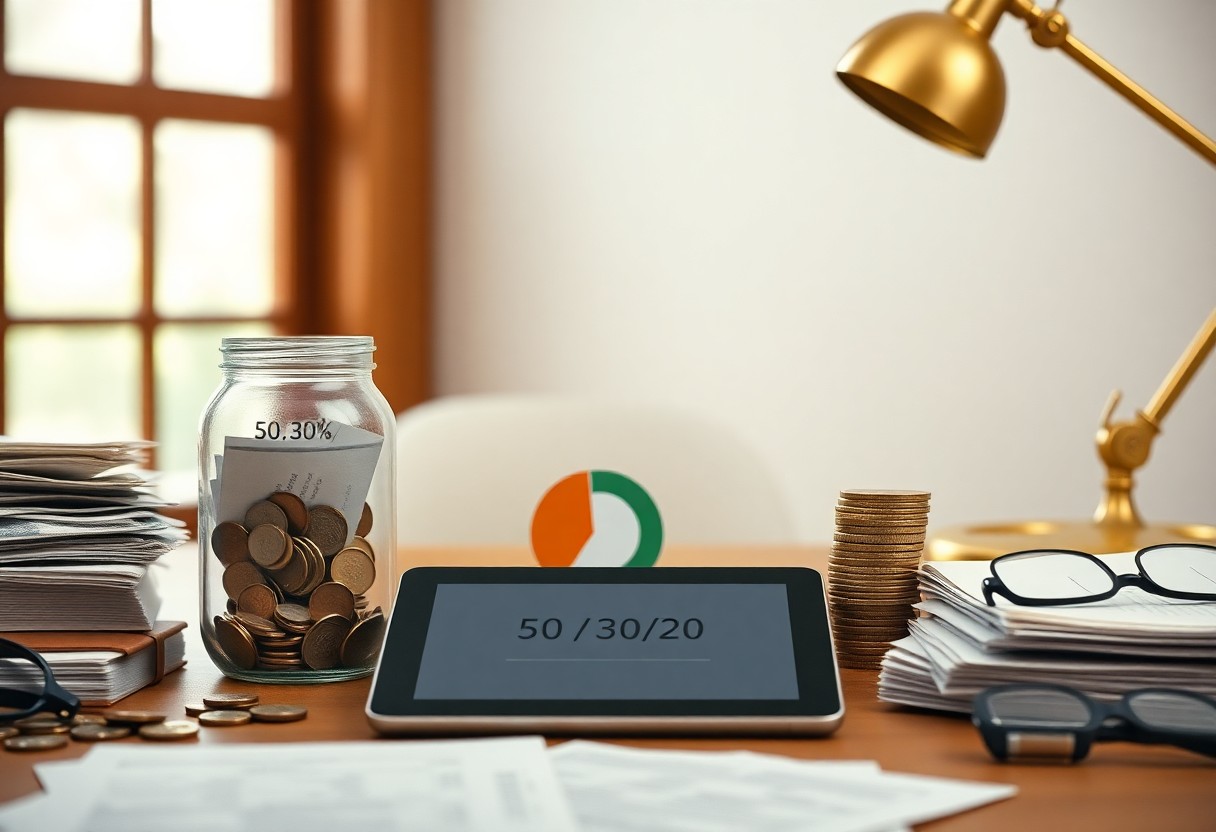
Budget frameworks like the 50/30/20 rule give you a clear allocation-50% for needs, 30% for wants, 20% for savings and debt-and a straightforward benchmark to evaluate your finances. This post evaluates where that split works, where it doesn’t, and how you can adapt it to your income, goals, and obligations to make it practical rather than prescriptive.
Key Takeaways:
- Simple framework: allocate 50% to needs, 30% to wants, 20% to savings and debt repayment – a useful starting point.
- Benefits: easy to follow, encourages consistent saving and clearer spending choices.
- Limitations: not one-size-fits-all – high housing costs, low income, or heavy debt often require adjusted ratios or alternative budgets.
Understanding the 50/30/20 Budget Rule
You use the 50/30/20 split to assign 50% of after-tax income to needs, 30% to wants, and 20% to savings and debt repayment. For example, on $4,000 net pay you’d budget $2,000 for rent, utilities and groceries; $1,200 for dining out, subscriptions and travel; and $800 toward an emergency fund, retirement, or extra loan payments-adjusting the proportions to fit your goals and local costs.
Breakdown of the Rule
Needs (50%) cover imperatives like mortgage or rent, utilities, insurance, and minimum loan payments; wants (30%) include nonimperatives such as entertainment, dining and travel; savings/debt (20%) funds emergency savings, retirement contributions, and extra principal payments. If you follow this on $4,000 net, target a three- to six-month emergency fund and at least enough retirement savings to capture any employer match.
Historical Context and Origin
Elizabeth Warren and her daughter Amelia Warren Tyagi popularized the 50/30/20 rule in their 2005 book All Your Worth, drawing on Warren’s bankruptcy-law research and practical work with household balance sheets. They presented the split as a straightforward response to the early-2000s U.S. environment of expanding consumer credit and low personal savings rates-offering a clear, easy-to-follow allocation for households under financial strain.
Advisors embraced the rule for its simplicity, but you’ll encounter limits: in high-cost metros where rent absorbs 30-40% of take-home pay, needs can easily exceed 50%, forcing a 60/20/20 or other adjustment. Evidence from low-income households shows the 20% savings target is often unrealistic, and if you carry high-interest debt (for example $10,000 at ~18% APR) prioritizing larger repayments until the balance drops is usually the wiser move.
Implementing the 50/30/20 Budget Rule
When you implement the 50/30/20 split, start with your net monthly income and assign 50% to needs, 30% to wants, 20% to savings/debt. For a practical walkthrough and tools consult The Power of 50/30/20 Budgeting Method. For example, on a $4,000 take‑home pay you’d allocate $2,000 to needs, $1,200 to wants and $800 to savings, then refine for irregular bills or high cost‑of‑living adjustments.
Steps to Create Your Budget
Track one full month of spending to identify patterns, then calculate your exact net income. Categorize expenses into needs, wants and savings and label every recurring charge. If your net is $3,200, allocate $1,600 / $960 / $640 respectively, set a 3‑month trial, and use automated transfers for the 20% to build consistency and avoid temptation.
Common Mistakes to Avoid
Misclassifying wants as needs inflates mandatory costs, while ignoring irregular bills (car insurance, annual subscriptions) skews the 50% target. Overallocating wants-say $700 of dining out on a $3,000 net-can push needs past 60%. Also avoid leaving the 20% idle; direct it to emergency savings and high‑interest debt repayment instead.
For instance, if you earn $5,000 after taxes and place a $350 gym membership under needs, your needs can hit 55%; shifting it to wants restores balance and speeds debt reduction. You should also build a buffer for quarterly bills equal to one month’s needs, and temporarily reduce wants to 20% if rent forces your needs above 50%.

Benefits of the 50/30/20 Budget Rule
Adopting this split gives you a clear framework: 50% for necessarys, 30% for discretionary choices, 20% for savings and debt. For instance, on a $4,000 monthly net income you’d allocate $2,000 to needs, $1,200 to wants, and $800 to savings-enough to build roughly $9,600 in a year. That predictability lowers mental load, speeds decisions about purchases, and creates a measurable path toward a 3-6 month emergency fund or accelerated debt repayment.
Financial Flexibility
Keeping 30% for wants and 20% for savings gives you maneuvering room when life shifts: a one-time car repair or a 5% rent increase can be absorbed by trimming wants or pausing discretionary spending. If you earn $3,000 net and save $600 monthly, you’ll have $3,600 after six months to cover unexpected shortfalls or bridge a temporary income drop, allowing you to avoid high-interest borrowing.
Simplicity and Ease of Use
The rule’s appeal is its simplicity: you only track three buckets, so setup takes minutes. Many people automate 20% to savings, route fixed bills from the 50% account, and use a debit card for the 30% account; on a $5,000 paycheck, scheduling $1,000 to savings each pay period removes guesswork and reduces missed payments.
To implement quickly, open three accounts or sub-accounts labeled Needs, Wants, Savings, and set automatic transfers on payday. Reassess every quarter: if your rent climbs or income fluctuates, shift small percentages between buckets rather than overhaul the plan. Tracking for 30 days reveals if your 30% wants cap is realistic, and quarterly reviews keep the system aligned with goals like a 3-6 month reserve or accelerating a $10,000 loan payoff.
Challenges and Limitations
The 50/30/20 rule often clashes with real-world numbers: median rents in high-cost cities can push housing to 40-60% of take-home pay, and someone earning $40,000/year may need 35-45% for necessities; see community experiences at is 50/30/20 realistic? : r/personalfinance where users share concrete budgets and adaptations.
Variability in Income
If you work freelance, commission, or seasonally, months of $2,000 versus $8,000 will break a strict 50/30/20 split. Use a 12-month rolling average to set allocations, keep a buffer of at least two months’ expenses, and direct windfalls (20-50% of extra income) toward smoothing funds, taxes, or debt; one contractor stabilized finances after averaging income over a year.
Unforeseen Expenses
Large one-off costs-$4,500 car repairs, $8,000 medical bills, or sudden unemployment-can erase your 20% savings fast; if your monthly expenses are $3,000, a three-month emergency fund equals $9,000, which is a more practical near-term goal than strict percentage adherence.
To protect yourself, build an emergency fund of 3-6 months’ expenses (6-12 months if self-employed) in a high-yield savings account, create sinking funds for predictable items (car maintenance $100/month, annual tax reserve ~25% of freelance earnings), and temporarily reallocate your “wants” percentage to savings until your buffer is restored.

Real-Life Success Stories
You’ll see these real outcomes when the 50/30/20 framework is applied: faster debt paydown, emergency funds built, and retirement progress. Several households kept the 50/30/20 split as a baseline while shifting small percentages temporarily to hit goals-one-year savings increases ranged from $6,000 to $24,000, and debt reductions of $4,800-$12,000 were common across the cases below.
Case Studies of Individuals and Families
Compare these anonymized examples to your situation; each lists income, monthly allocations, and measurable results so you can gauge feasibility and timelines.
- If you’re a single professional, age 28, earning $48,000/year (gross $4,000/mo): needs $2,000, wants $1,200, savings $800 – saved $9,600 in 12 months and paid off $6,000 of credit-card debt in 9 months by redirecting 10% of wants temporarily.
- If you’re a dual-income family, combined $120,000/year ($10,000/mo): needs $5,000, wants $3,000, savings $2,000 – built a $24,000 emergency fund (3 months of $8,000 total expenses) within 12 months while keeping retirement contributions steady.
- If you’re a freelancer averaging $60,000/year (variable, ~ $5,000/mo): used a 3-month average, allocated $2,500/50%, $1,500/30%, $1,000/20% – paid down student loans from $40,000 to $28,000 in 18 months and increased retirement savings from 5% to 15% of income.
- If you’re on fixed retirement income $54,000/year ($4,500/mo): needs $2,250, wants $1,350, savings $900 – trimmed wants by $300/mo to cover rising medical costs and added $1,200/year to a health buffer.
- If you’re a single parent earning $36,000/year ($3,000/mo): needs $1,500, wants $900, savings $600 – consolidated high-interest debt, reduced APR from 22% to 9%, lowered interest payments ~$160/mo and paid off $4,800 in 12 months.
Lessons Learned from Budgeting Experiences
You’ll find the rule works best as a starting template: automate the 20% savings, treat the 50% cap on needs as negotiable in high-cost areas, and track monthly cashflow so you can reassign small percentages when goals change. Several cases succeeded by reviewing allocations every quarter and shifting 5-10% temporarily toward debt or emergency savings.
Practical tactics that helped people you can emulate include splitting accounts (one for needs, one for wants, one for savings), setting automatic transfers the day after payday, and recalculating the 50/30/20 split when your gross income changes by 10% or more; doing so shortened debt timelines by 25-40% in multiple cases.
Alternatives to the 50/30/20 Budget Rule
Other Budgeting Methods
You can adopt zero-based budgeting where every dollar has a job – if you earn $4,000, you allocate all $4,000 across rent, groceries, savings and debt; the envelope system forces discipline by using cash envelopes (for example $400 groceries, $150 dining) to cap spending; pay-yourself-first automates savings (commonly 10-20% to retirement and 5-10% to an emergency fund); sinking funds split annual bills into monthly chunks, and freelancers often reserve 25-30% for taxes.
Tailoring Your Approach to Fit Your Needs
If your income varies or you carry high-interest debt, shift allocations: someone with $5,000 monthly income and 18% credit card balances might move to 40% necessarys, 30% debt repayment, 30% savings until balances fall; if you need a $30,000 down payment in 18 months you’d need about $1,667 monthly, so bump savings to meet that target; adjust percentages for family size, cost of living, and short-term goals.
Start by auditing last three months of spending, set one clear goal (debt, house, emergency fund), then test new percentages for 60-90 days; automate transfers to savings, create a tax/sinking fund (self-employed often keep 25-30% aside), and smooth variable income by using a 12-month rolling average to set your baseline so you don’t under- or over-commit when months swing.
Conclusion
From above, the 50/30/20 rule gives you a clear, flexible framework to allocate needs, wants, and savings, and it works well as a starting point if you adapt percentages to your income, goals, and cost of living; you should treat it as a guideline rather than a rigid mandate, monitor your progress, and adjust categories when debt, family changes, or savings targets demand different priorities.
FAQ
Q: What is the 50/30/20 rule and does it work for everyone?
A: The 50/30/20 rule divides after-tax income into three buckets: 50% for needs (rent/mortgage, utilities, groceries, minimum loan payments), 30% for wants (dining out, entertainment, subscriptions), and 20% for savings and debt repayment. It works well as a simple starting framework because it forces prioritization and makes trade-offs visible. It does not fit everyone-people in high cost-of-living areas, households with large debt burdens, or those with ambitious short-term goals may need different percentages. Use it as a flexible guideline, not a rigid law: evaluate your obligations, goals, and timeline and adapt the ratios accordingly.
Q: How can I adapt the 50/30/20 rule to different incomes, debts, or financial goals?
A: Start by calculating your reliable after-tax monthly income, then track actual spending for 1-3 months. If needs exceed 50%, shift the split (example: 60/20/20 or 55/15/30) until important expenses are covered. If you have high-interest debt, allocate more than 20% to accelerate payoff until interest is manageable. If your goal is aggressive saving (home down payment, early retirement), increase savings to 30-50% and cut wants. For variable or seasonal costs, create sinking funds inside the needs category (car repairs, insurance). High earners should consider raising the savings/investment portion and funding tax-advantaged accounts before increasing discretionary wants.
Q: What common mistakes do people make when following the 50/30/20 rule and how do I avoid them?
A: Common mistakes include misclassifying expenses (treating required payments or recurring importants as “wants”), ignoring irregular or annual costs, not accounting for taxes or benefits changes, and using the rule without tracking actual spending. To avoid these, itemize and categorize three months of transactions, create sinking funds for irregular needs, prioritize paying down high-interest debt before treating debt service as a stable “need,” and automate transfers to savings and bills. Reassess the split after major life changes (move, job change, new child) and adjust percentages to align with realistic cash flow and goals.