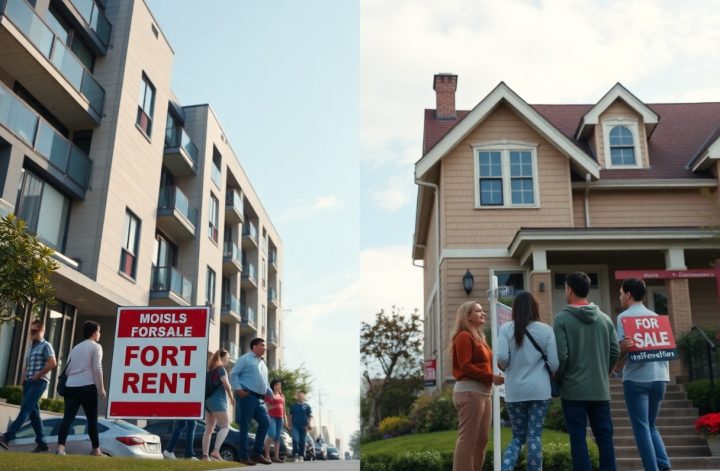
Most of your choices about where to live balance financial realities and lifestyle goals, and this guide shows you how to evaluate costs, flexibility, and long-term benefits so you can decide whether renting or buying best fits your priorities and timeline.
Many factors determine whether you should rent or buy your first home; you should assess your financial readiness, job stability, and long-term plans before deciding. Compare monthly costs, upfront expenses like down payment and closing fees, and the responsibilities of maintenance and repairs. Consider how long you expect to stay, local market trends, and the value of building equity versus preserving flexibility so you can choose the option that fits your goals.
Key Takeaways:
- Compare total costs – factor in down payment, closing costs, mortgage, taxes, insurance, maintenance and the opportunity cost; use a rent-vs-buy calculator to find the breakeven horizon.
- Match choice to your time horizon and lifestyle – buying often pays off if you plan to stay about 5+ years; renting offers flexibility for short-term plans or uncertain job/life changes.
- Weigh financing and local market conditions – favorable mortgage rates and strong appreciation favor buying; high rates, weak markets, or a need for low commitment favor renting.
Key Takeaways:
- Compare total costs: include down payment, closing costs, mortgage interest, taxes, insurance, and maintenance versus monthly rent and renter’s insurance to see which fits your budget.
- Match housing choice to your timeline and flexibility needs: buy if you plan to stay 5+ years and want equity; rent if you need mobility or short-term options.
- Factor in market and personal readiness: evaluate interest rates, local home-price trends, emergency savings, and willingness to handle repairs before deciding.

Understanding Your Financial Situation
To decide whether renting or buying fits your finances, tally your net worth, emergency fund size, and target down payment; aim for 3-6 months of expenses and a down payment between 3% (some programs) and 20% to avoid PMI. Use the 28/36 rule as a guide: keep housing costs under ~28% of gross income and total debt-to-income (DTI) under 36-43% for mortgage approval. Run scenarios to see how interest-rate changes affect monthly payment.
Assessing Your Income and Expenses
Start by listing your stable monthly net income and all fixed and variable expenses; include utilities, transport, student loans, and childcare. Lenders favor 2+ years of steady employment, and if you have variable income-commissions or freelancing-average the last 24 months. Use a spreadsheet to calculate discretionary cash flow and test if 30% of gross pay covers a projected mortgage plus taxes and insurance without dipping into savings.
Evaluating Your Credit Score
Start by knowing your FICO score range (300-850); 740+ is excellent, 670-739 good, 580-669 fair, below 580 is poor. Many lenders require at least 620 for conventional loans, while FHA allows 580 for 3.5% down. Higher scores typically lower interest rates – a 700+ score can mean rates several tenths of a percent better than a 640 score, translating to hundreds per month on a typical mortgage.
Pull your free credit reports at AnnualCreditReport.com and review for errors; successful disputes can add 10-50 points quickly. Lower your card utilization under 30%-ideally below 10%; for example, a $2,500 balance on a $5,000 limit goes from 50% to 20% if you pay $1,500. Keep old accounts open, avoid opening new credit in the 3-6 months before applying, and prioritize on-time payments to lift scores over 6-12 months.
Understanding Your Financial Situation
Analyze your income stability, existing debts and liquid savings to decide whether renting or buying fits your current finances. Lenders often prefer a debt-to-income ratio below 43%, and you should aim for 3-6 months of living expenses in emergency savings if you buy. Expect down payments from about 3% (certain programs) up to 20% to avoid mortgage insurance, plus closing costs roughly 2-5% of the purchase price.
Assessing Your Budget
List your gross monthly income and fixed obligations, then calculate front-end (housing) and back-end (total debt) ratios; lenders commonly use about 28% and 36-43% respectively. If your gross income is $5,000, keeping housing near $1,400 aligns with a 28% guideline. Factor in maintenance (around 1% of home value per year), property taxes and insurance, and set down payment goals-3%-20% depending on loan type-plus 2-5% for closing costs.
Evaluating Credit Scores
Pull your credit reports and note scores from each bureau; conventional loans typically require 620+ while FHA accepts 580 for a 3.5% down payment, and scores 740+ earn the best market rates. You’ll find lenders price loans by score bands, so knowing your exact score helps decide whether to buy now or boost it first. Scan reports for errors that could reduce your qualifying power.
You can materially improve offers by raising your score: reduce credit card balances below 30% utilization, make every payment on time, and avoid new inquiries in the months before applying. Disputing report errors often yields quick lifts, and moving from a 620 to a 740-range score can lower your rate enough to save roughly $175-180 per $300,000 each month for a 1% reduction in interest.
Evaluating Lifestyle Preferences
Assess practical factors like commute time, social life, and maintenance tolerance: if you value easy access to nightlife and walkability, a central rental may suit you; when you need a backyard for pets or kids, ownership in the suburbs often fits better. Consider travel frequency-renting lets you relocate in months, while selling a house typically takes 30-90 days and incurs 5-6% agent fees plus closing costs. Factor these trade-offs against your daily routines and hobbies to align housing with how you live.
Considering Your Long-Term Goals
If you plan to stay in one place 7+ years, buying usually builds equity and can beat renting over time: with a $300,000 purchase and 20% down, you start with $60,000 equity and gain principal paydown plus market appreciation. Conversely, if career plans or education may move you in 1-4 years, renting preserves liquidity and avoids transaction costs like 2-5% closing fees and 5-6% sales commissions that can eat into short-term gains.
Weighing Flexibility vs. Stability
Renting gives flexibility to change neighborhoods or jobs with minimal cost, while buying delivers stability-fixed-rate mortgages lock a portion of housing costs and allow renovations and customization. For example, average annual rent increases can be 2-4%, whereas a fixed mortgage keeps principal and interest steady; choose based on whether mobility or home control matters more to your lifestyle.
Dig deeper by running scenarios: selling a $300,000 home may cost ~7-11% total in commissions and closing, plus about 1% of value yearly in maintenance, so moving within 3 years often leaves you worse off financially than renting. On the other hand, if you plan to age in place, prefer DIY projects, and want tax and equity benefits, a 30-year mortgage with steady payments can provide long-term financial predictability and personal freedom to modify your space.
Pros and Cons of Renting
You gain predictable monthly budgeting and limited maintenance responsibility when you rent, but you don’t build equity and face potential rent inflation; security deposits typically equal 1-2 months’ rent and leases often run 6-12 months. You also avoid the 3-20% down payment and 2-5% closing costs required to buy. For a numerical comparison, see Buying vs. Renting: A Financial Analysis.
| Pros | Cons |
|---|---|
| Lower upfront cash required (deposit vs down payment) | No equity accumulation-monthly payments don’t build ownership |
| Flexible lease terms (6-12 months common) | Rent increases over time (often a few percent annually) |
| Landlord handles major repairs and maintenance | Limited control over renovations, decor, and pets |
| Easier to relocate for work or family | Lease-breaking fees can be costly (commonly 1-2 months’ rent) |
| Access to higher-cost neighborhoods with lower commitment | Smaller living space for the same monthly cost compared to buying |
| Predictable short-term costs (rent, utilities, renters insurance) | Fewer tax advantages than homeownership (limited mortgage deductions) |
| Opportunity to save for a down payment while renting | Long-term rent can exceed cumulative mortgage costs |
| Lower responsibility for landscaping and exterior upkeep | Risk of eviction or non-renewal if landlord sells or changes terms |
Flexibility and Mobility
If you expect career moves or want to test neighborhoods, renting gives you agility: leases commonly last 6-12 months, and you can relocate without selling property. You should factor in moving costs and possible lease-break fees-often equal to 1-2 months’ rent-when planning short-term moves, and use this flexibility to prioritize job opportunities or lifestyle changes without the delays of a home sale.
Lower Upfront Costs
You typically pay first month, last month, and a security deposit (1-2 months’ rent) plus moving expenses and renters insurance, which is often $10-30 monthly. That contrasts with buying, where a 3-20% down payment plus 2-5% closing costs can be required, so renting preserves cash for emergencies, investments, or a future down payment.
For example, if you rent at $1,500/month you might pay $1,500-3,000 upfront for deposits and $500-2,000 to move; buying a $300,000 house at 10% down requires $30,000 down plus $6,000-$15,000 in closing costs. You can use that liquidity to build credit, invest, or cover short-term needs while you prepare to buy.
Analyzing the Housing Market
When you weigh rent versus buy, track months of inventory, median price changes and mortgage rates-markets under 4 months supply with 10-20% gains over three years often favor buying, while 6-8%+ rates raise monthly carrying costs; run localized scenarios and use frameworks like When the Math Supports Buying Your Primary Residence … to quantify outcomes for your timeline.
Researching Local Market Trends
Track sales-to-list ratios, median price per square foot and months of inventory in your neighborhood; a sales-to-list ratio above 98% signals less negotiation room and faster appreciation. Check building permits and rental vacancy rates for supply signals, and compare three-year price trends-if values rose more than 12% you may capture equity faster, but factor in higher rates or HOA fees that can offset gains.
Understanding Property Value Fluctuations
Expect values to swing with interest rates, job growth and inventory: a single large employer adding 5,000 jobs often pushes demand and can raise prices 5-10% in nearby ZIP codes within 12-24 months. You should map major employers, school ratings and zoning changes, and stress-test scenarios-what happens to your payment if rates rise 2 percentage points or if nearby inventory doubles.
Also examine micro-level drivers: recent comparable sales within six months, cap-rate expectations for rentals (typically 4-8% in suburban markets), and local permitting-projects that add 300+ units can flatten rents and prices. Calculate your break-even horizon: with 3% annual appreciation and 2% transaction costs, you’d need roughly seven years to offset buying costs; adjust that if you expect higher appreciation or rent inflation in your area.
Pros and Cons of Buying
You gain equity and stability but face upfront costs and ongoing obligations: typical down payments are 3-20% (FHA vs conventional), closing costs run 2-5% of price, and annual maintenance averages 1-3% of home value. For example, on a $300,000 purchase with 20% down, you start with $60,000 equity but should budget $6,000-$9,000 yearly for repairs, taxes, and insurance; market swings can raise or wipe out gains in the short term.
| Pros | Cons |
|---|---|
| Builds equity as you pay principal and property appreciates | Requires sizable upfront cash (down payment + 2-5% closing costs) |
| Potential tax benefits (mortgage interest and property tax deductions) | Property taxes and insurance can rise unpredictably |
| Stable monthly payments with a fixed-rate mortgage | Less mobility-selling within 3-7 years may not recoup transaction costs |
| Ability to renovate and increase value | Maintenance and repairs average 1-3% of home value annually |
| Possible rental income from extra rooms or units | Landlord duties or property management costs if you rent it out |
| Forced savings through amortization | Long-term interest cost can be large (30-year loan interest ≈ 60-80% of principal over life) |
| Appreciation can outpace inflation historically (e.g., ~3%/yr average) | Market risk-local values can fall for years after purchase |
| Predictable investment compared to short-term stock volatility | Opportunity cost: capital tied up versus other investments with higher liquidity |
Building Equity
You increase ownership through principal payments and appreciation: on a $300,000 home with 20% down ($60,000), a 3% annual appreciation plus typical principal reduction can nearly double your equity in a decade-value might rise to ≈$403,000 and mortgage principal paid could add tens of thousands, boosting your net stake beyond the initial down payment.
Long-Term Financial Commitment
You commit to decades of payments and ancillary costs: a $240,000 mortgage at 4% over 30 years results in roughly $413,000 total paid, meaning about $173,000 in interest; add annual maintenance (1-3% of value) and rising taxes, and your ongoing cash needs can exceed $10,000-$12,000 yearly on a mid-priced home.
When you model scenarios, compare break-even timelines: closing costs 2-5% (≈$6,000-$15,000 on a $300k home) plus realtor fees when selling make short-term moves costly-typically 5-7 years to recoup transaction and renovation costs. Factor in emergency reserves (3-6 months of expenses plus 1-3% of home value annually), possible refinancing at different rates, and the opportunity cost of tying up your down payment versus investing in index funds that historically returned ~7% annually. Running an amortization schedule and stress-testing local market downside by 10-20% helps you see whether buying fits your multi-year plans.
Calculating the True Costs
When you total costs, look past monthly figures: account for down payment (commonly 20% to avoid PMI), closing costs (2-5% of price), property taxes (~1% yearly), homeowners insurance ($600-1,500/year), HOA dues, and a maintenance reserve (roughly 1% of home value annually). For a $300,000 house you might front $60,000 down plus $6,000-$15,000 closing costs and face about $3,000/year in taxes and upkeep, so first‑year cash and ongoing carrying costs reshape the rent vs. buy decision.
Comparing Rent vs. Mortgage Payments
If you run the numbers, a $300,000 home with 20% down and a 30‑year fixed mortgage at 4% yields principal & interest near $1,155/month; adding ~1% property tax ($250/month) and $80 insurance produces PITI ≈ $1,485. That sits close to a $1,500 rent, but your mortgage payment builds equity and can remain stable while rent often climbs 2-5% annually, affecting long‑term cost comparisons.
Rent vs Buy: Quick Monthly Comparison
| Rent | Buy |
|---|---|
| $1,200-$2,000 typical monthly (varies by market) | $1,000-$2,000 P&I plus taxes, insurance, HOA |
| Low upfront (deposit + first month) | High upfront (down payment, 2-5% closing costs) |
| Flexible, easier to move | Stable mortgage (if fixed rate) and equity build |
| Landlord handles major repairs | You pay maintenance (~1% of home value/year) |
| No mortgage interest deduction | Mortgage interest and property tax may offer tax benefits |
Factoring in Maintenance and Upkeep
You should budget for ongoing maintenance: a common rule of thumb is about 1% of the home’s value per year-so a $300,000 house implies roughly $3,000/year or $250/month for routine upkeep and small repairs; older homes usually require more, and renters typically avoid these line items beyond deposits.
Plan for larger, irregular costs as well: roof replacements often run $7,000-$15,000, HVAC units $3,000-$7,000, and water heaters $800-1,500. If the home is older than 20 years, double your reserve to 2-3% of value. You can fund this by setting aside $250-$500/month (for a $300,000 home at 1-2%), keeping an emergency cushion of $5,000-$10,000, and reviewing inspection reports to prioritize near‑term replacements before closing. HOA fees can shift some maintenance risk but add to your monthly carry cost.
Key Factors to Consider
You’ll weigh upfront costs like down payment (3-20% of price) and closing fees (commonly 2-5%), ongoing carrying costs (mortgage, taxes, insurance, maintenance), and local rent-versus-buy signals such as price-to-rent ratios above 20 favoring renting; job stability, commute time, and planned renovations also change the math. Any single factor-for example needing a 20% down payment that drains your emergency fund-can make renting the safer short-term choice.
- Down payment & closing costs: 3-20% + 2-5% fees
- Monthly budget: mortgage P&I, taxes, insurance, HOA, maintenance
- Local market metrics: price-to-rent ratio, months of inventory
- Time horizon and mobility: planned moves in 1-5 years
- Credit score & loan qualification: affects rate and approval
Market Conditions
You should monitor mortgage rates and local supply: a $300,000 loan at 6.5% yields roughly $1,894 monthly P&I versus about $1,347 at 3.5%, a $547 gap that alters affordability; low inventory under three months typically drives bidding and price growth, while 6+ months signals buyer leverage. Also track local appreciation-3-5% annual gains change break-even timelines for buying versus renting.
Future Plans and Stability
If you expect to stay under three years, renting often wins because buying incurs 2-6% transaction costs plus agent fees near 5-6% on sale; you generally need about 5-7 years to recoup those costs given typical 3-4% appreciation. Your job prospects, family timeline, and willingness to handle repairs determine how ownership fits your stability needs.
Dive into scenarios: if your employer may relocate you in 1-2 years, factor potential selling in a downturn and agent fees; by contrast, planning to stay 7+ years with forecasted 20-30% income growth increases the value of equity accumulation-principal reductions of ~1-2% of loan balance yearly plus appreciation. Check projected debt-to-income (lenders often target <43%), emergency reserves (3-6 months), and how those buffer ownership risks.
Exploring Financing Options
You’ll weigh monthly costs, upfront cash and long-term equity; buying often needs a 3-20% down payment while renting usually requires a security deposit equal to one month’s rent. Use lender quotes and rent-vs-buy calculators, and read this comparison: Buying vs renting a home: The pros & cons explained to compare scenarios and tax implications.
Different Types of Mortgages
You can choose fixed-rate (commonly 15- or 30-year) for payment stability, or an ARM that starts lower and adjusts; FHA loans allow about 3.5% down, VA can be 0% for eligible veterans, and USDA targets rural buyers-15-year terms often shave 0.5-1% off rates but raise monthly payments.
| Fixed-rate (15/30) | Stable monthly payment; 15-year cuts interest, 30-year lowers payment |
| Adjustable-rate (ARM) | Lower initial rate for 3-10 years, then adjusts with caps |
| FHA | Low down (~3.5%); higher mortgage insurance, easier credit thresholds |
| VA | No down for qualified veterans; no PMI, strict occupancy rules |
| USDA | Rural properties, income limits, possible zero-down financing |
- Compare APR, not just the nominal rate, because fees change total cost.
- Ask lenders for rate quotes with identical points and fees to make apples-to-apples comparisons.
- Thou must factor property taxes, insurance and HOA into monthly affordability calculations.
Pre-Approval and its Importance
You should get a pre-approval letter-lenders verify income, assets and credit to state a conditional loan amount; most letters last 60-90 days and strengthen offers in competitive markets by signaling you’re a serious buyer.
When pursuing pre-approval, gather pay stubs (30 days), W-2s (2 years), recent bank statements and tax returns; aim for a debt-to-income ratio under ~43% for conventional loans and a credit score typically 620+ (FHA can be lower with higher down). Lenders perform a hard credit pull, so avoid new credit applications before closing; shop multiple lenders for rate and fee differences and get the pre-approval in writing to present with offers.

Tips for Making Your Decision
Pinpoint practical priorities-monthly budget, commute time, and how long you plan to stay-and compare full costs: example rent $1,600 vs owning $2,200/month (30-year mortgage) plus 1-2% property tax and 1% insurance. Use quick checks:
- Run a rent-vs-buy calculator with a 3-5% appreciation assumption and 2-6% transaction costs.
- Check local vacancy and rent-growth rates-city cores often see 2-4% annual rent increases.
- Estimate upkeep at 1-3% of home value per year for maintenance and reserves.
Recognizing that your weighting of flexibility, cost, and long-term gains will determine the best choice for you.
Seeking Professional Advice
Talk to a mortgage broker to compare rates-brokers often source 0.25-0.5% better offers-and get preapproval to set realistic price limits. Ask an agent for neighborhood comps and days-on-market, and consult a CPA or financial planner to model tax impacts and cashflow; note the $250,000/$500,000 capital gains exclusion for primary residences. Bring 12 months of statements and your credit score so professionals can run precise scenarios tailored to your goals.
Weighing Personal Preferences
Assess lifestyle trade-offs: if you expect to move within 3 years, transaction and selling costs (2-6% of price) typically favor renting; leases usually run 12 months and breaking one can cost a month’s rent. Owning demands time-plan 8-12 hours monthly for maintenance-and emotional attachment to a neighborhood can justify extra cost. Rank how much you value stability, customization, and mobility to guide the decision.
Run a side-by-side scenario: buying a $300,000 home with 10% down and 3% closing costs versus renting at $1,600/month-assuming 3% annual appreciation and 1.5% maintenance, break-even often falls around 5-7 years; if you expect a job move in 2-3 years, renting usually saves money after sale-related fees. Use a spreadsheet to vary appreciation, rent growth, and selling costs to identify your personal break-even horizon.

Making the Decision
Weigh short- and long-term costs: if you plan to stay 3-7 years or longer, buying often offsets transaction and maintenance costs through equity and tax benefits; if mobility under 3 years is likely, renting may be cheaper. Use calculators and scenario analysis and consult discussions like Buying vs. Renting: A Financial Analysis to compare breakeven timelines and regional price trends.
Creating a Pros and Cons List
Quantify each item in dollars and years: list monthly cost differences, potential appreciation rates (e.g., 2-5% annual), expected maintenance ($1,000-3,000/year), and mobility value, then total projected 5- and 10-year outcomes to see which column wins for your specific numbers.
Pros and Cons
| Pros | Cons |
|---|---|
| Equity build-up over time | High upfront costs (down payment, closing) |
| Predictable principal & interest payments | Maintenance and repair expenses |
| Potential tax deductions (mortgage interest) | Property taxes can rise |
| Freedom to renovate | Less geographic flexibility |
| Long-term appreciation potential | Market risk and price volatility |
| Forced savings via mortgage payments | Transaction costs when selling |
| Stable housing for family planning | Opportunity cost of tied capital |
| Ability to rent out for income | Landlord responsibilities |
| Build credit history with mortgage | Qualification requirements (income, credit) |
| Access to home equity loans later | Potential for negative equity in downturns |
Seeking Professional Advice
Talk to a mortgage broker, a buyer’s agent, and a fee-only financial planner to get tailored numbers: brokers often compare rates that can differ by 0.25-1.0% between lenders, agents can show comparable sales (CMAs) to estimate likely offers, and planners model cashflow impacts over 5-30 years so you know the real cost of each choice.
Bring recent pay stubs, bank statements, tax returns (2 years), and a list of monthly expenses when you meet advisers. Ask for rate quotes, estimated closing costs, and scenarios for 3-, 5-, and 10-year horizons. Expect a CFP hourly rate roughly $150-400 and broker fee structures that may be 0.5-1% or rolled into the loan; get written estimates before committing.

Common Pitfalls to Avoid
You can avoid costly mistakes by not overextending on mortgage approvals, skipping inspections, or underfunding an emergency account; lenders may approve debt-to-income ratios up to 43%, but paying that much often squeezes savings and retirement contributions. Also watch for rushed buys in bidding wars, underestimating commute or childcare costs, and assuming appreciation will cover poor decisions-these habits turn a seemingly affordable purchase into a long-term financial strain.
Overspending on Housing
You shouldn’t let lenders dictate comfort: the traditional 28% front-end ratio is a starting point, but aim for housing costs under 25-30% of your take-home pay to maintain liquidity. For example, on $75,000 gross income (about $4,800 net monthly), a 30% cap means ~$1,440 for rent or mortgage; exceeding that can reduce retirement contributions and emergency savings, increasing financial vulnerability after job loss or unexpected repairs.
Ignoring Hidden Costs
You must account for closing costs (typically 2-5% of purchase price), PMI if you put down under 20% (around 0.5-1% annually), property taxes, homeowner’s insurance, HOA fees, and routine maintenance-on a $300,000 house that could mean $6,000-$15,000 closing, $1,500-$3,000 PMI per year, and roughly $3,000 annual maintenance. Overlooking these items inflates your true monthly and yearly housing burden.
You should build a 3-5 year cost projection that includes large-ticket replacements-roof ($7k-$12k), HVAC ($4k-$8k), foundation or septic repairs (often $10k+), and potential property tax hikes of 2-3% annually. Request recent utility bills, HOA meeting minutes for special assessments, and a thorough inspection report to quantify short-term fixes versus long-term capital expenses before you commit.
To wrap up
Considering all points, you should weigh your financial readiness, lifestyle needs, and long-term goals when choosing between renting and buying; compare rent flexibility versus building equity, factor in down payment, mortgage qualification, taxes and maintenance, assess local market conditions, run conservative affordability calculations, and consult a lender or advisor so your choice aligns with your timeline and risk tolerance.
Final Words
Presently, weigh your finances, lifestyle, and timeline: if you have stable income, savings for a down payment, and plan to stay several years, buying builds equity and may lower long-term housing cost; if you need flexibility, lack savings, or anticipate job or life changes, renting reduces upfront cost and maintenance responsibility. Use clear budget projections and a time horizon to decide.
FAQ
Q: How do I compare the real monthly cost of renting versus buying?
A: Add up all recurring and one-time costs for each option. For buying include mortgage principal and interest, property taxes, homeowners insurance, private mortgage insurance (if down payment <20%), HOA fees, routine maintenance (estimate 1-3% of home value annually), and ongoing utilities. Spread closing costs (about 2-5% of purchase price) over your expected ownership period. For renting include monthly rent, renter's insurance, utilities, and any deposits or broker fees. Compare net monthly cash flow and build scenarios showing how principal paydown and home price appreciation affect net worth. Run sensitivity checks for changes in interest rates, home appreciation (±1-3% yearly), and unexpected repairs. Use a rent-vs-buy calculator to find the break-even point and test different down payments and loan terms.
Q: How long should I plan to stay in a home before buying makes sense?
A: Account for transaction costs: buying and later selling typically consumes about 6-10% of the sale price through closing costs, commissions, and fees. Because of these upfront and exit costs, buying generally makes more financial sense if you plan to stay long enough to recoup them-commonly five to seven years in many markets, but this varies with local transaction costs and expected appreciation. If you expect to move within a few years, renting often offers lower short-term risk and greater flexibility. If your job, family plans, or personal preferences are uncertain, consider renting or shorter-term ownership options like condos or townhomes that can be easier to sell or rent out.
Q: What non-financial factors should influence my decision to rent or buy?
A: Prioritize lifestyle and flexibility needs: renting offers mobility, fewer maintenance responsibilities, and simpler exits; buying gives control over renovations, more stability, and potential community ties. Consider your tolerance for maintenance and unexpected repairs, desire to customize living space, need for predictable housing costs (fixed-rate mortgage vs. rent increases), and how important neighborhood permanence, local schools, and long-term roots are. Also weigh emotional factors-homeownership can provide pride and routine but can also add stress if local markets decline. If community, customization, and long-term stability matter more than short-term flexibility, buying may be preferable; if career mobility, lower responsibility, or saving for other goals is a priority, renting may be better.