Programs designed to help you with student loan debt can make a big difference in your financial future. Navigating these options might feel overwhelming, but understanding them is key to finding relief. In this post, you’ll discover ten federal student loan forgiveness programs that you should be aware of. Each program has unique requirements, so you can find the one that fits your situation best. Read on to unlock the potential for reduced or even eliminated student loan debt!
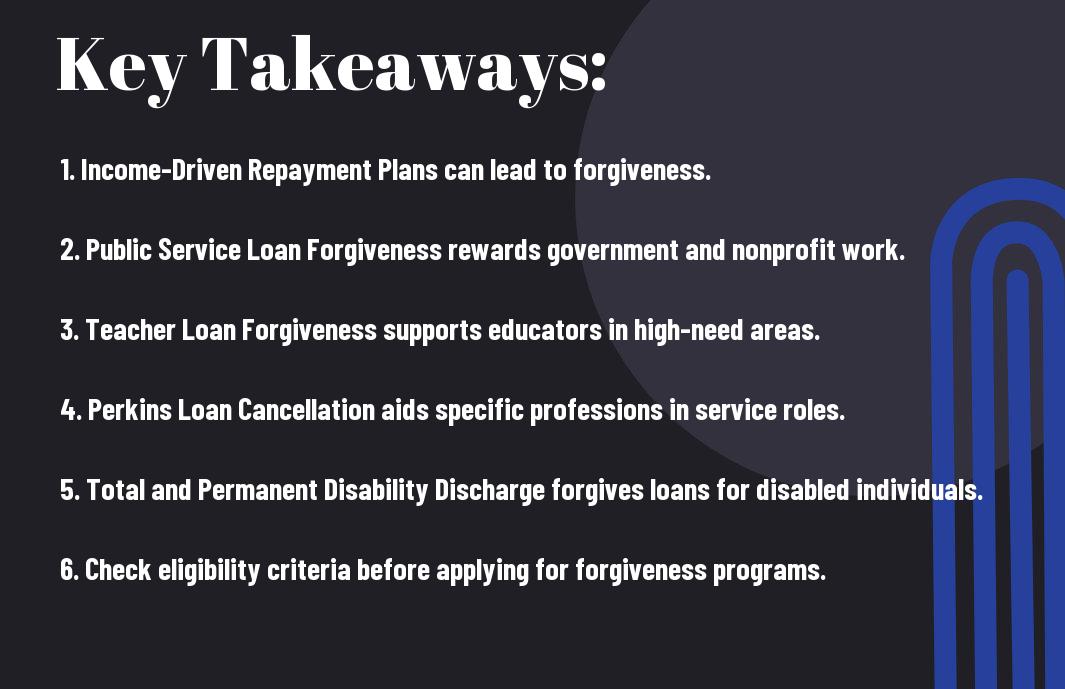
Key Takeaways:
- Multiple federal student loan forgiveness programs exist, each catering to different career paths and circumstances. It’s important to research which one fits your situation best.
- Eligibility for forgiveness often depends on factors like employment, repayment plan, and timeline. Make sure to understand the specific criteria for each program.
- Staying organized is key. Keep track of your repayments, employment status, and any required documentation to ensure you meet the requirements for forgiveness.
Income-Driven Repayment Forgiveness
Before you probe your career, you may find yourself overwhelmed by student loan payments. Fortunately, Income-Driven Repayment (IDR) plans can help you manage those payments based on your earnings. If your income is low, your monthly payment might also be low, and after a set period, any remaining loan balance may be forgiven. This program can make life a bit easier while you’re building your future.
Adjusts for Income
If your earnings change, your IDR payment will adjust accordingly. This means that if your salary goes up, your payments might increase. Conversely, if your income decreases due to job changes or other factors, your monthly payment will lower. This flexibility helps ensure that your student loans remain manageable throughout your career.
After 20-25 Years
To qualify for forgiveness, you will typically need to make payments for 20 to 25 years, depending on the specific IDR plan you choose. Each type of plan may have different terms. After you meet this requirement, any remaining balance will be forgiven, giving you relief from the burden of student debt.
Any remaining balance after 20 or 25 years can significantly lighten your financial load. It allows you to focus on saving for other life goals, like buying a home or starting a business. Make sure you keep track of your payments over the years, as this can help ensure you get that forgiveness when the time comes. Understanding these timelines and requirements is key to taking full advantage of this benefit.

Public Service Loan Forgiveness
The Public Service Loan Forgiveness (PSLF) program is designed to help individuals who dedicate their careers to public service. This includes government jobs or non-profit organizations. If you meet specific criteria, you could have your federal student loans forgiven after making 120 qualifying payments. This program can significantly ease your financial burdens and reward your commitment to serving the community.
For Government Employees
If you work for a government agency at any level—federal, state, or local—you could qualify for the PSLF program. Your job in public service can help you gain loan forgiveness after ten years of consistent payments on your federal student loans.
Non-profit Organization Workers
Now, if you are a worker at a non-profit organization, you also have the chance to benefit from PSLF. This includes both full-time and part-time positions, as long as your employer qualifies under the program guidelines. Non-profit work, much like government jobs, counts toward your 120 qualifying payments.
To ensure you qualify, your non-profit organization must be recognized as tax-exempt. This type of employment can be rewarding, supporting important causes while helping you get your student loans forgiven. Keep track of your payments, and make sure to fill out the Employment Certification Form regularly to confirm your eligibility for the program.
Teacher Loan Forgiveness
Once again, teacher loan forgiveness offers a great opportunity for educators to relieve some of their student debt. This program is designed to help teachers who commit to working in low-income schools for a certain period. By teaching in these areas, you can qualify for forgiveness on a portion of your federal student loans, making it a fantastic benefit for those dedicated to education.
For Eligible Teachers
Any teacher who works in a low-income school can apply for this loan forgiveness program. To be eligible, you must have been a full-time teacher for five consecutive years at a qualifying school. This includes public and private elementary and secondary schools that serve a large population of students from low-income families.
Five Consecutive Years
You’ll need to commit to teaching for five consecutive years to qualify for loan forgiveness. This means you must stay in the same school, or a similar qualifying school, during this time. Your commitment to education helps provide stability for students and builds your eligibility for forgiving part of your student loans.
The benefits of completing five consecutive years as a teacher involve not only the financial relief through loan forgiveness but also the personal growth and community impact you experience. As an educator, your dedication can change lives, and the loan forgiveness reflects that commitment. It’s an opportunity to make a difference while also easing your financial burden.
Closed School Discharge
Not every federal student loan borrower knows about the Closed School Discharge program. This program offers forgiveness for loans if your school shuts down while you are enrolled. If you qualify, it can relieve you from the burden of repaying your loans. Understanding how it works can help you navigate your financial options if your educational institution closes its doors.
School shuts down
With the unpredictable nature of education, schools may occasionally close unexpectedly. When this happens, it can leave you without the education you planned to complete. Fortunately, the law helps by allowing students to apply for a discharge of their federal loans if the school closure occurs while you are enrolled or shortly after your withdrawal.
Eligible students only
School closures impact many students, but not everyone is eligible for loan forgiveness. You must have been enrolled at the school at the time it closed or withdrawn less than 120 days before the closure. If you meet these criteria, you can apply for a Closed School Discharge with your loan servicer.
Plus, you do not need to show that you completed your program to qualify. This means that even if you were only partway through your studies, you may still receive forgiveness. Be sure to gather any documentation proving your enrollment, as this will support your application. Familiarizing yourself with the process can provide peace of mind during this challenging time.
Total and Permanent Disability Discharge
Keep in mind that if you are totally and permanently disabled, you may qualify for a Total and Permanent Disability (TPD) Discharge. This program allows you to have your federal student loans canceled. To be eligible, you need to prove that your disability prevents you from working and is expected to last indefinitely. This benefit can provide significant financial relief and help you focus on your recovery.
Total Disability
On a basic level, total disability means you are unable to perform any substantial work due to a physical or mental impairment. This condition must be permanent, meaning it is expected to last indefinitely. If you meet this definition, you can apply for the TPD Discharge and eliminate your student loan debt.
Special Application Needed
You need to submit a special application to access the Total and Permanent Disability Discharge. Simply having a disability does not automatically qualify you. In your application, you must provide documentation from a qualified physician or other acceptable proof of your disability. This detailed process ensures that only eligible individuals receive this discharge and can help you alleviate your student loan burden.
To successfully apply, gather all necessary documents that support your claim of total and permanent disability. Start by obtaining a signed statement from your doctor stating that you are unable to work due to your condition. Once you have this information, fill out the application and submit it to your loan servicer. Be patient, as it may take some time for your application to be processed. Following these steps will guide you through the process of securing the financial relief you deserve.
Military Service Discharge
Despite the challenges you may face, military service can lead to significant benefits for federal student loan forgiveness. If you have served in the military, you might qualify for discharge options that can relieve you of debt. For more details, check 6 Student Loan Forgiveness Programs—Do You Qualify?.
Active-duty members
Activeduty service members can take advantage of unique loan forgiveness opportunities. If you are currently serving, your loans might be canceled or reduced after a period of service. This can provide you with financial relief as you focus on your vital duties.
Eligible for benefits
If you have been discharged for specific reasons, you may be eligible for even more benefits. This includes those who have served in certain roles or experienced hardships during their time in service. Your eligibility will depend on the nature of your discharge and the type of loans you have.
With the right information, you can navigate the military benefits landscape. Understanding your eligibility is key. Make sure to consult your loan servicer and explore options available to you. This way, you can maximize your benefits and lighten your financial load.
Federal Family Education Loan Cancellation
All Federal Family Education Loans (FFEL) can be canceled under certain conditions. This program offers relief to borrowers who have difficulty repaying their loans due to specific circumstances. With FFEL cancellation, you may be eligible to have part or all of your loans forgiven depending on your situation, like total and permanent disability, the closure of your school, or if you’ve been a victim of fraud.
Special Professions
You’ll find that certain professions qualify for FFEL cancellation. Jobs in education, nursing, and public service may allow you to have some or all of your federal student loans forgiven. If you work in these fields and meet specific requirements, it’s worth exploring how this cancellation can benefit you.
Worked in Certain Fields
Clearly, working in certain fields greatly increases your chances of loan cancellation. To qualify, you generally need to serve in a position that addresses a critical need, such as teaching in low-income schools or providing healthcare in underserved areas. By dedicating your career to these necessary roles, you can not only make a positive impact but also relieve part of your student loan burden.
To make the most of these opportunities, you should document your service in qualifying fields. Always check the specific requirements for loan forgiveness related to your job. Being proactive can help you understand the steps to take for possible loan cancellation and ensure you receive all eligible benefits.

Bankruptcy Discharge
To qualify for a bankruptcy discharge on federal student loans, you must prove undue hardship. This process can be challenging, but it is possible in some cases. If you want to learn more, check out Everything to know about student loan forgiveness. Keep in mind that this option is rarely successful and involves a court process, so being informed is crucial.
Rare Cases
Assuming you find yourself in extreme circumstances, discharging your student loans through bankruptcy might be feasible. Courts often look at each case individually, meaning some rare cases can lead to forgiveness.
Significant Hardship
Rarely, you may qualify for a discharge if you demonstrate significant financial hardship. This usually requires showing that you cannot maintain a minimal standard of living while repaying your loans.
Discharge through significant hardship can include proving that your current financial situation, such as job loss or medical issues, prevents you from paying your loans. Courts consider several factors, including your income, expenses, and future earning potential. If you think you qualify, gathering necessary documentation and seeking legal counsel may help your case.
Borrower Defense to Repayment
After you have been misled by your school or faced misconduct, you might qualify for Borrower Defense to Repayment. This program can help you eliminate your federal student loans if your school engaged in dishonest actions that directly harmed you. For more details about Student Loan Forgiveness, visit the official site.
School Misconduct
Misconduct by your school can lead to serious issues with your education and student loans. If your school violated state laws or engaged in unethical practices, you could be eligible for loan forgiveness. It’s important to gather evidence of the misconduct, as this will support your claim.
Misleading Information
An important aspect of Borrower Defense is when your school provides misleading information. This can include false promises about job placement rates, program costs, or the quality of education. When you relied on this incorrect information to make decisions about your education, you deserve a chance to have your loan forgiven.
Misleading claims can significantly impact your financial and educational choices. If your school advertised job placement rates that were not true or made unrealistic promises, you may have grounds for a Borrower Defense application. Keeping records of any misleading information you received is vital to making your case stronger. By addressing these issues, you can work toward achieving loan forgiveness.

Natural Disaster Discharge
Many borrowers may not be aware that federal student loans can be discharged due to natural disasters. If you are affected by a significant event, such as a hurricane, flood, or wildfire, you might qualify for financial relief. This program allows you to have your loan forgiven if your ability to repay it has been severely impacted by the disaster.
Affected by Disasters
Now, if you have been affected by a natural disaster, it’s important to understand your options. The government recognizes the hardships that come with these events, and there are specific guidelines to help you through the process. Look into how this discharge can ease your financial burden, so you can focus on rebuilding.
Eligible Loans Only
On the topic of eligibility, not all loans qualify for discharge under this program. Only certain federal loans are eligible, such as Direct Loans and Stafford Loans. You need to check your loan type and ensure that it meets the criteria before applying for the natural disaster discharge.
Natural Disaster Discharge applies specifically to federal loans. This means that if you have private student loans, they will not qualify for this discharge. Before proceeding, find out the exact type of federal loan you have. This will help you determine your eligibility and the correct process to follow for a potential discharge. Ensuring your financial stability during tough times is important, and this program can play a key role in helping you recover.
Final Words
From above, you now have a clear understanding of the 10 federal student loan forgiveness programs available to you. Each program has specific requirements and benefits that can lighten your financial burden. By being informed about your options, you can take steps towards reducing your student loan debt. Take the time to explore these programs and see which ones fit your situation best. Your journey toward financial freedom can start with the right information and actions.
10 Federal Student Loan Forgiveness Programs You Need to Know
Are you feeling overwhelmed by your student loans? You’re not alone! Many students and graduates are looking for ways to ease their financial burdens. Fortunately, there are several federal student loan forgiveness programs available. In this blog post, we will explore ten of these programs, explaining who qualifies and how they can help you. Let’s dive in!
What is Student Loan Forgiveness?
Student loan forgiveness is when some or all of your student loan debt is canceled. This means you won’t have to pay it back. Forgiveness can help you save money and lower your financial stress.
1. Public Service Loan Forgiveness (PSLF)
The PSLF program is designed for people who work in public service jobs. Here’s what you need to know:
– Qualifying Jobs: Non-profit organizations, government sectors, and teaching.
– Requirements: Make 120 qualifying monthly payments under a qualifying repayment plan while working full-time.
2. Teacher Loan Forgiveness
If you are a teacher, this program can help.
– Qualifying Schools: Low-income schools or educational service agencies.
– Benefits: You may be eligible for forgiveness of up to $17,500 on your loans.
3. Income-Driven Repayment (IDR) Forgiveness
This program offers forgiveness after making payments for a certain period based on your income.
– Timeframe: Depending on the plan, after 20 or 25 years of qualifying payments.
– Plans: Includes Income-Based Repayment (IBR), Pay As You Earn (PAYE), and others.
4. National Health Service Corps (NHSC) Loan Repayment Program
If you work in health care, check out the NHSC program.
– Eligibility: Must provide care in a high-need area.
– Benefits: Receive up to $50,000 for two years of service.
5. Perkins Loan Cancellation
This program helps borrowers who are working in specific professions.
– Qualifying Jobs: Teaching, nursing, law enforcement, and more.
– Benefits: Up to 100% of the loan can be canceled.
6. U.S. Navy Nurse Corps Program
Nurses in the Navy may be eligible for loan forgiveness.
– Eligibility: Active duty nurses serving in the Navy.
– Benefits: Up to $40,000 in student loan repayment assistance.
7. Department of Defense (DoD) Loan Repayment Program
If you serve in the military, this program can help with your loans.
– Eligibility: Active duty members of the armed forces.
– Benefits: Up to $65,000 in student loan repayment.
8. Federal Employees Student Loan Forgiveness
This program is for federal government employees.
– Eligibility: Full-time federal employees.
– Benefits: Up to $10,000 in student loan forgiveness.
9. Child Care Provider Loan Forgiveness
If you are a child care provider, you may qualify.
– Requirements: Must work for a qualifying employer.
– Benefits: Up to $2,500 can be forgiven depending on service.
10. State-Sponsored Forgiveness Programs
Many states have their own loan forgiveness programs.
– Eligibility: Varies by state; often for teachers or health professionals.
– Benefits: Depends on the specific state program.
Key Takeaways
– Review the eligibility requirements for each program carefully.
– Keep all your documents in order to prove your qualifying payments.
– Don’t hesitate to ask your loan servicer for help navigating these programs.
By taking advantage of these federal student loan forgiveness programs, you can relieve some of the financial burden associated with student loans. Be proactive and explore which options work best for you!
FAQs about Student Loan Forgiveness Programs
Q: What is the Public Service Loan Forgiveness program?
A: The Public Service Loan Forgiveness (PSLF) program forgives student loans for borrowers who work full-time in qualifying public service jobs after making 120 qualifying monthly payments.
Q: How do I qualify for Teacher Loan Forgiveness?
A: To qualify for Teacher Loan Forgiveness, you must teach full-time for five complete and consecutive years in a low-income school or educational service agency. You may receive up to $17,500 in loan forgiveness.
Q: How does Income-Driven Repayment (IDR) Forgiveness work?
A: IDR Forgiveness allows eligible borrowers to have their remaining loan balance forgiven after making payments based on their income for 20 or 25 years, depending on the plan.
Q: Can health professionals benefit from loan forgiveness programs?
A: Yes, health professionals can participate in programs like the National Health Service Corps (NHSC) Loan Repayment Program, which provides loan repayment for those who work in underserved areas.
Q: Are there any state-sponsored forgiveness programs available?
A: Yes, many states offer their own loan forgiveness programs, often aimed at teachers or health professionals. Eligibility and benefits vary by state.
By understanding these programs, you can make informed decisions about your student loans and find potential relief. Don’t hesitate to reach out to your loan servicer for clarity and assistance!