This guide shows you how to build a reliable emergency fund from the ground up, with clear steps for setting goals, trimming expenses, automating savings, and choosing the right accounts so you can weather unexpected costs without derailing your finances. Follow this plan to grow your cushion steadily and confidently.

Key Takeaways:
- Set a realistic target by calculating necessary monthly expenses and aiming for 3-6 months of coverage; if that feels large, start with a $1,000 starter goal.
- Automate savings with recurring transfers, cut nonnecessary costs, and direct bonuses or tax refunds to boost the fund faster.
- Keep the fund liquid and separate (high-yield savings or money market), use it only for true emergencies, and rebuild promptly after any withdrawal.
Understanding Emergency Funds
What is an Emergency Fund?
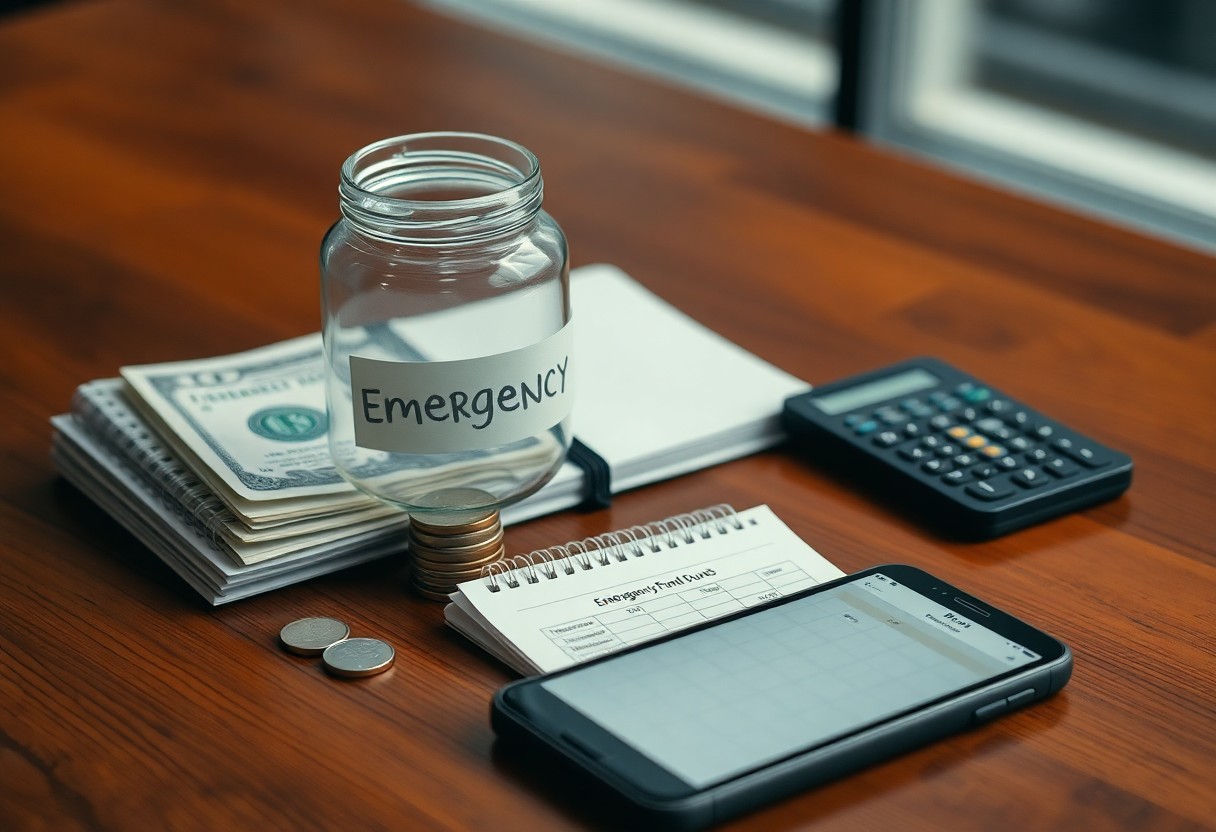
An emergency fund is a dedicated, liquid savings buffer you use for unexpected expenses like car repairs, sudden medical bills, or unemployment. Financial planners typically recommend 3-6 months of vital expenses; for example, if your rent, food, and bills total $3,000/month, you’d aim for $9,000-$18,000. Keep it accessible in a high‑yield savings or money‑market account, not in long‑term investments.
Importance of Having an Emergency Fund
If you lack a fund, you’ll likely rely on high‑interest credit cards (often 15-25% APR) or payday loans that can trap you in debt; the Federal Reserve found roughly 40% of adults couldn’t cover a $400 emergency without borrowing. With a properly sized fund you can cover immediate needs, avoid interest costs, and buy time to secure steady income after job loss.
To deepen that protection, tailor the size to your risk: 3-6 months is a baseline, but 6-12 months makes sense if you’re self‑employed, the sole earner, or in a volatile field. Store the money in an accessible account-online high‑yield savings often yield 1-4% APY-and build it by automating transfers, allocating windfalls, or saving a side‑gig’s first $200/week (about $10,400/year).
Assessing Your Financial Situation
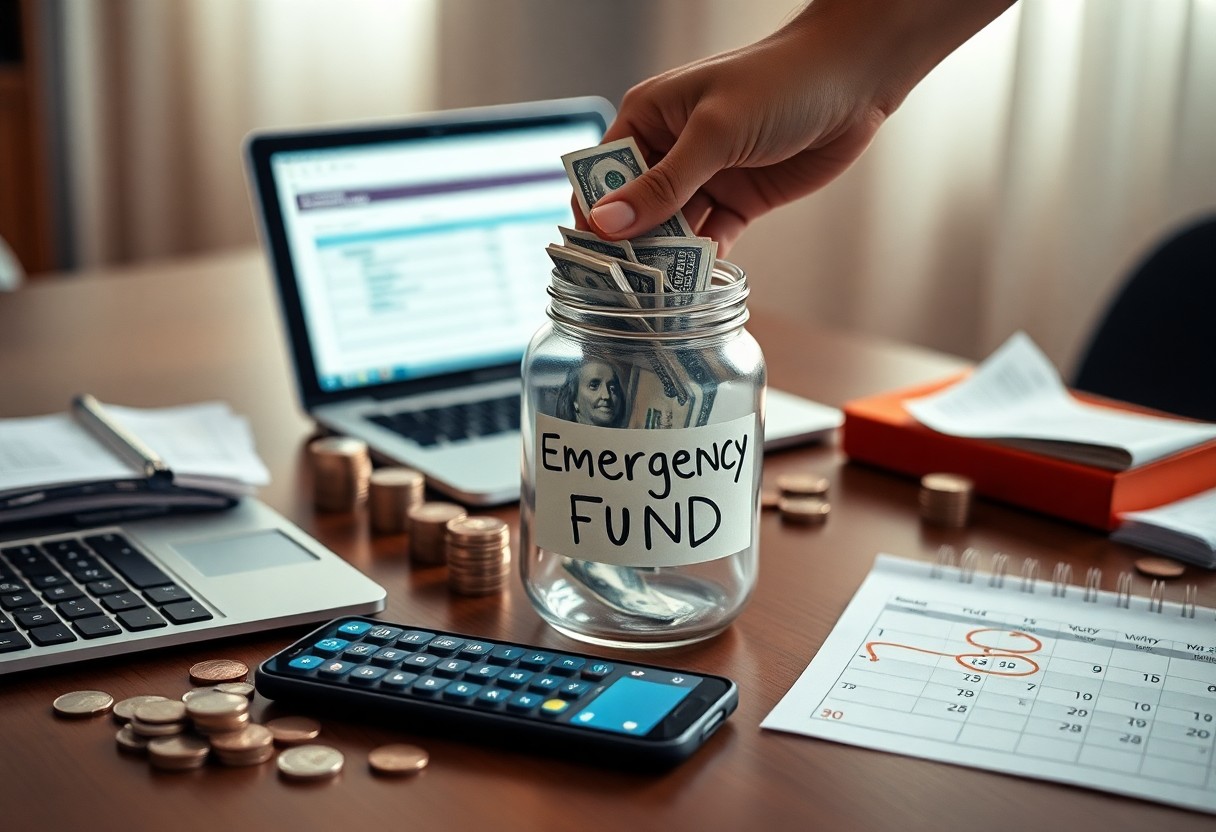
Calculate your baseline by totaling three to six months of vital costs – housing, utilities, groceries, insurance – and include minimum monthly debt payments; if vitals run $2,000/month, a 3-month fund equals $6,000. Check how quickly you can access cash from savings, brokerage accounts, or a credit line and factor that into your target. For a practical roadmap on setting timelines and milestones, follow 5 steps to build an emergency fund.
Evaluating Current Expenses
You should examine 60-90 days of bank and card statements, categorize spending into vitals (rent, utilities, groceries, insurance) and nonvitals (streaming, dining out), then calculate monthly averages; for example, rent $1,200 + groceries $350 + utilities $150 = $1,700 vitals. Identify subscriptions and discretionary items that free up meaningful amounts – cutting $50/week dining saves about $200/month or $2,400/year – and allocate that directly to your fund.
Identifying Income Sources
List every income stream you have: salary, freelance gigs, rental receipts, dividends, side-hustle cash; if your W-2 income is $3,500/month and side gigs add $400, your gross monthly is $3,900. Evaluate stability and after-tax net for each source – seasonal freelance might drop 40-60% some months – then commit the stable portion to consistent contributions.
Dig deeper by separating gross versus net receipts and estimating taxes: if freelance pay is $400/month, set aside ~25-30% for self-employment taxes and quarterly payments, leaving roughly $280-300 net. Consider one-time boosts too – selling unused items for $500 or taking a short freelance sprint that nets $600 can jump-start your fund; even an extra $200/month from a steady side hustle adds $2,400 annually, speeding you toward your target. Automate deposits from the most reliable income streams until you hit your goal, then reassess allocation.

Setting Realistic Goals
Set goals based on clear milestones: start with a $1,000 buffer, then target 3-6 months of your necessary living costs. If you’re self-employed or have irregular income, aim for 9-12 months. Use practical methods like buckets and automation in planning; see An necessary guide to building an emergency fund for step-by-step options and examples.
Determining the Target Amount
You can calculate targets by totaling your necessary monthly costs: if rent is $1,200 and utilities plus food run $600, your 3-month target is $5,400 and 6 months is $10,800. If you support children or have variable income, increase the multiplier to 6-12 months. Also factor in predictable one-time costs-expected medical bills or appliance replacements-so your cushion matches realistic risk.
Timeline for Building Your Fund
Set a timeline that aligns with income and obligations: to reach $6,000 in 12 months you need $500 per month; in 6 months that’s $1,000 per month. Aim to save 5-20% of your net pay depending on other priorities, and automate transfers so you treat savings like a recurring expense rather than a discretionary choice.
You can accelerate the timeline by funneling windfalls-tax refunds, bonuses, or extra gig income-directly into the fund; for example, a $2,000 bonus reduces a $500/month, 12-month plan to about eight months. Automate increases after pay raises, cut subscriptions to free $25-$100 monthly, and reassess the schedule after major life changes so targets stay achievable.
Tips for Saving Effectively
Start by setting a small target like $500, then scale toward 3-6 months of expenses and treat the fund like a fixed monthly bill. Use simple rules: save 10% of each paycheck, stash $50 after side-gigs, and funnel raises directly into savings.
- Set a 30-day sprint goal: $500 in 2 months
- Automate transfers on payday
- Track progress with a spreadsheet or app
Perceiving small wins keeps you motivated and helps you maintain the habit.
Automating Savings
Set an automatic transfer on payday-start with 5-10% or a fixed $50 per deposit; saving $100 monthly nets $1,200 in a year. Use your bank’s split-deposit or a separate high-yield account (current APYs vary 1.5%-4%) so interest compounds. Employers can direct deposit to multiple accounts, and apps like Digit or Chime round up purchases to turn spare change into reliable contributions.
Cutting Unnecessary Expenses
Audit monthly outflows: cancel unused subscriptions, consolidate streaming, and reduce dining out. Two $15 subscriptions canceled saves $30/month ($360/year); brewing your $3 coffee instead of a $5 shop cup three times weekly saves ≈$312/year. Reallocate these sums straight into your emergency fund to speed progress with minimal lifestyle disruption.
Use a 30-day spending freeze to test what you truly need and track every expense; you’ll likely spot $50-$200 monthly leak points. Negotiate bills-asking for a $20 monthly discount on internet or insurance saves $240 annually-and switch to lower-cost phone or utility plans. Employ subscription-tracking apps and set quarterly reminders so you catch creeping fees before they erode your savings momentum.
Choosing the Right Savings Account
Focus on APY, fees, and protections when selecting an account. You can find online high-yield options offering roughly 2-5% APY versus 0.01-0.10% at many local branches; weigh that yield against monthly fees, minimum-balance requirements, and whether a rate is introductory. Verify FDIC insurance up to $250,000 per depositor and compare transfer limits, ATM access, and how quickly you can move money into checking when an emergency hits.
High-Yield Savings Accounts
High-yield accounts at online banks often deliver 2-5% APY and commonly have no monthly fees or minimums, which boosts your fund growth: for example, a $10,000 balance at 3% yields about $300 a year versus under $10 at 0.1%. You should check whether rates are promotional (often lasting 6-12 months), confirm automatic rate adjustments, and review provider reputations-Ally, Marcus, and Capital One are examples of institutions that frequently offer competitive, no-minimum options.
Accessibility and Liquidity
Access matters because emergencies require quick funds; choose accounts with debit-card or ATM access for same-day cash, and note that ACH transfers from online banks typically take 1-3 business days unless you pay for instant transfer service (often 0.5-1.5% per transfer). Also verify ATM withdrawal limits-many cards cap cash at $500-$1,000 daily-and any outbound transfer caps that could delay you when time is critical.
You can improve readiness by splitting your emergency fund: keep one to two weeks’ expenses (e.g., $500-$2,000) in checking for immediate use and the remainder in a high-yield account with 1-3 business-day transfer times. When comparing providers, look for same-day ACH options, ATM fee reimbursement policies, and hold times on large mobile check deposits (some banks hold funds up to 5 business days), since those details determine how fast you can access your money.
Maintaining Your Emergency Fund
Set a quarterly check-in to compare your fund against three to six months of important expenses and adjust for inflation; if rent or insurance rises 5-10% year-over-year, increase contributions proportionally. Move the balance into a high-yield savings or money-market account offering 0.5-4% APY to beat typical checking rates, and keep the fund separate from daily accounts so you avoid accidental spending.
When to Use the Fund
Use the fund for true emergencies: involuntary job loss, unexpected medical bills, or urgent home and car repairs that threaten safety or financial stability. For example, a sudden transmission replacement commonly costs $1,500-$3,000, and out-of-network ER visits often exceed $1,200; you should tap savings for expenses that you cannot cover without borrowing at high interest.
Replenishing the Fund After Use
After a withdrawal, prioritize replenishment by setting a target timeline-ideally within 3-6 months-and automate transfers accordingly; if you withdrew $3,000 and can save $500/month, you’ll restore the balance in six months. Allocate windfalls like tax refunds or bonuses to speed recovery and temporarily trim discretionary spending to meet the goal.
Break the replenishment into staged goals: restore 50% in the first month to regain buffer, then rebuild the remainder over the next months with $100-$500 weekly or monthly contributions. Consider a side gig that nets $200-$600/month and route that income directly to the fund, while tracking progress with a simple spreadsheet or app so you can see milestones and stay motivated.
Final Words
Upon reflecting, you can see that building an emergency fund begins with clear goals, steady saving habits, and prioritizing liquidity over short-term wants. Set automatic transfers, trim nonimperative expenses, and grow your buffer until it covers several months of expenses. With discipline and a simple plan, you protect your finances and gain confidence to handle unexpected costs.
FAQ
Q: How much should I aim to save for an emergency fund?
A: Aim for at least three to six months of basic living expenses for most people; plan for six to twelve months if you have variable income, are self-employed, or support dependents. Calculate your baseline monthly needs by totaling rent or mortgage, utilities, groceries, insurance, minimum debt payments, transportation, healthcare, and childcare. Multiply that monthly subtotal by the target number of months, and add a modest buffer for predictable irregular costs (car repairs, prescriptions). Adjust the target as your job stability, monthly obligations, and household size change.
Q: I’m starting from zero and have very little spare cash – how do I build an emergency fund?
A: Start with a small, achievable goal (for example $500-$1,000) to cover immediate small emergencies, then scale up to your full target. Automate transfers of even $10-$50 per paycheck into a separate account so saving happens before you can spend it; treat savings like a fixed bill. Free up cash by trimming subscriptions, negotiating bills, reducing discretionary spending temporarily, or selling unused items. Use windfalls (tax refunds, bonuses) and any extra income from side work to accelerate progress. Track progress in a simple spreadsheet or app and increase the automated amount as your budget allows.
Q: Where should I keep an emergency fund for safety and accessibility?
A: Keep the money liquid and low-risk but not in the same checking account you use for daily spending. Good options are high-yield savings accounts, money market accounts, or a short-term CD ladder with staggered maturities if you want a bit more yield without locking everything up. Ensure accounts are FDIC- or NCUA-insured and easy to access for genuine emergencies; avoid investing the fund in stocks or long-term bonds that can fluctuate. Consider using a separate account name or bank to reduce temptation to dip into it, and review the account setup after major life events so coverage stays appropriate.