You can build lasting wealth by investing in index funds with a disciplined, low-cost strategy; this guide shows you how to choose funds, set allocation, automate contributions, manage risk, and minimize taxes so your portfolio grows steadily over decades. Follow practical steps to align investments with your goals, maintain diversification, and avoid timing the market while keeping fees and behavior under control.
Key Takeaways:
- Use low-cost, broad-market index funds for diversified exposure and reduced single-stock risk.
- Invest consistently over time (dollar-cost averaging), keep a long-term horizon, and avoid market timing.
- Set an asset allocation aligned with risk tolerance, rebalance periodically, and minimize fees and taxes using low-cost funds and tax-advantaged accounts.
Understanding Index Funds
You’ll see index funds act as low-cost, diversified building blocks that replicate a market index-like the S&P 500 or the Total Stock Market-so your returns mirror broad market performance; many leading ETFs charge expense ratios as low as 0.03% and historically deliver competitive long-term returns versus active managers, making them efficient for long-term wealth accumulation.
What are Index Funds?
Index funds are pooled investments that track a specific benchmark by holding the same or a representative sample of its securities, so you avoid stock-picking risk; for example, the S&P 500 funds hold roughly 500 large-cap U.S. companies while total-market funds like VTI cover ~3,500-4,000 stocks, giving you wide exposure with minimal fees.
Types of Index Funds
You can choose between broad-market, market-cap-weighted, equal-weighted, sector, international, and bond index funds; large-cap S&P 500 funds (e.g., VOO/IVV) focus on 500 firms, total-market funds (VTI) cover thousands, and bond indexes like AGG track the Bloomberg U.S. Aggregate for fixed-income exposure.
- Compare expense ratios-top core ETFs often sit between 0.03% and 0.10%.
- Watch tracking error; under 0.10% is typical for major large-cap funds.
- Any allocation should match your risk tolerance and investment horizon.
| Index | Example |
| Large-cap equity | S&P 500 (VOO, IVV) |
| Total market | VTI (~3,500-4,000 U.S. stocks) |
| International | MSCI EAFE / FTSE ex-US (VEU) |
| Bonds | Bloomberg U.S. Aggregate (AGG) |
For Types of Index Funds in practice, you’ll weigh trade-offs: sector funds like XLK concentrate in tech and can outperform in cycles but raise volatility; international funds add currency and geopolitical variance yet often lower portfolio correlation; bond index funds provide income with typical durations around 5-7 years depending on the index.
- Use sector funds to tilt exposures when you have conviction or tactical views.
- Rebalance annually to maintain target allocations and capture buy-low opportunities.
- Any change to your core should be deliberate and cost-aware.
| Type | Typical example & note |
| Broad US | VTI – covers the whole U.S. market |
| Large-cap | VOO/IVV – S&P 500, concentrated in top 500 firms |
| Sector | XLK – technology-heavy, higher volatility |
| International/Bonds | VEU/AGG – ex-US equity and aggregate bonds for diversification |

How to Start Investing in Index Funds
You can begin by picking the right account type-taxable brokerage, Traditional or Roth IRA, or your 401(k)-then fund it regularly and choose funds with low expense ratios (often 0.03%-0.20%) and minimal purchase minimums. ETFs let you avoid many mutual-fund minimums, while robo-advisors charge about 0.25%-0.50% for automated portfolios. For a curated list and step-by-step choices see The Best Index Funds and How to Start Investing.
Choosing a Brokerage Account
You should compare fees, available index funds, order types, and tools; many brokers like Fidelity, Schwab, and Vanguard offer $0 commissions and fractional shares. Look for no account maintenance fees, easy IRA transfers, and automatic investment options. Mutual funds sometimes require $1,000-$3,000 minimums, while ETFs trade like stocks with no minimum, so ETF-friendly brokers are ideal if you want low-entry investing.
Setting Investment Goals
You need to define time horizon, target balance, and risk tolerance-short horizons favor more bonds, long horizons favor higher stock allocation. For instance, a 30+ year horizon might use roughly 90% stocks/10% bonds; a 10-year horizon could shift to 60/40. Also set contribution rates (many aim for 10%-15% of income) and an annual rebalance schedule to maintain your target allocation.
For a practical example, if you save $500/month and earn a 7% annual return, you’d reach roughly $570,000 in 30 years, illustrating how contribution size and assumed return drive outcomes. Use target-date funds or a simple core-satellite index mix to automate asset allocation, and track progress quarterly to adjust contributions or risk as life events change your horizon or goals.
Key Factors to Consider
Assess your time horizon, risk tolerance, tax situation, and liquidity needs when selecting index funds; a 30-year horizon typically favors equity-heavy allocations while a 5-year horizon pushes you toward bonds or cash. Compare fund structures (ETF vs. mutual fund), tracking error, and how often you’ll rebalance. Knowing how these elements interact lets you tailor a low-cost, diversified portfolio aligned with your goals.
- Time horizon (e.g., 5, 10, 30+ years)
- Risk tolerance and volatility capacity
- Expense ratios, trading costs, and tracking error
- Diversification by market cap, sector, and geography
- Tax efficiency and account type
Expense Ratios and Fees
Fees shave returns every year: Vanguard’s VOO and iShares’ IVV charge about 0.03%, SPY is around 0.09%, while many active funds charge 0.5-1.0%. If you hold $100,000, a 0.5% higher fee costs roughly $500 annually and compounds over decades into a material difference. You should prioritize low expense ratios, watch bid-ask spreads, and account for any platform commissions.
Market Capitalization and Diversification
You’ll choose between large-, mid-, and small-cap exposure: S&P 500 funds concentrate on large-cap firms, Russell 2000 (IWM) targets small-cap, and total-market funds like VTI span the full cap spectrum. Tilting toward mid- or small-cap can boost long-term returns but raises volatility; a simple starting split might be 70% large-cap, 20% mid-cap, 10% small-cap depending on your risk appetite.
Beyond caps, pay attention to geographic and sector diversification: U.S. large-cap indexes can be top-heavy in a few mega-cap names, so adding international (e.g., VEA, VWO) and sector-balanced funds reduces single-market and sector concentration. Consider market-cap-weighted versus equal-weighted funds-equal weighting (RSP-style) reduces mega-cap dominance but increases turnover and tax events, so match the approach to your tax status and rebalancing discipline.
Tips for Long-Term Success
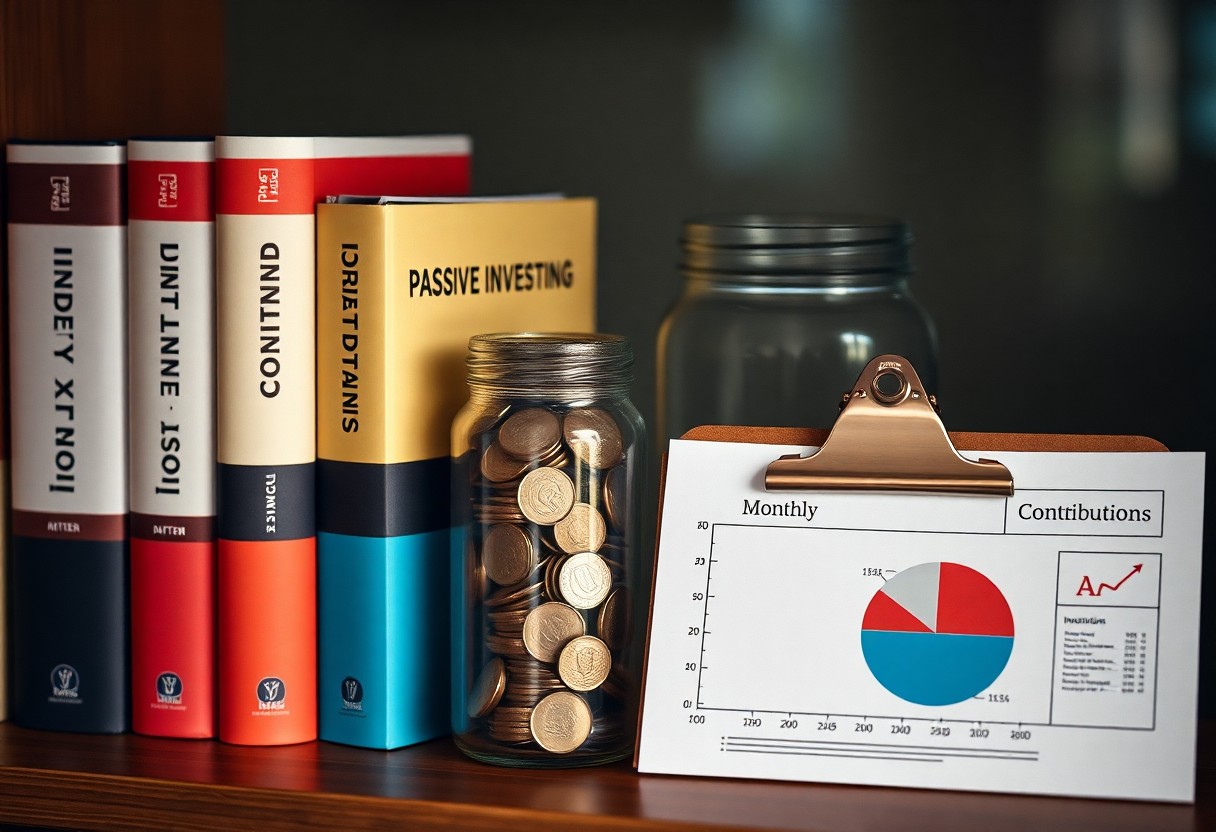
- You should automate contributions and raise them with pay increases; aim for 10-15% of income and always capture any employer match (for example, a 50% match on the first 6% equals an immediate 3% return).
- Choose ultra-low-cost index ETFs or mutual funds-look for expense ratios under 0.10% (VTI at ~0.03% is a common example) to keep fees from eroding returns.
- Use dollar-cost averaging: set monthly transfers so you buy across market cycles and avoid mistimed lump-sum decisions.
- This enforces discipline: set simple rules like rebalancing when allocations drift by ±5 percentage points or on an annual schedule.
Consistent Contributions
You should automate monthly investments into index funds, aiming for at least 10% of income and increasing with each raise; capturing a full employer match alone can boost returns by roughly 3% of salary. Prioritize emergency savings first, then funnel excess into tax-advantaged accounts. For example, making $200-$500 monthly contributions consistently compounds over decades and harnesses dollar-cost averaging to lower average purchase price and reduce timing risk.
Rebalancing Your Portfolio
You should rebalance annually or when any asset class drifts by about 5 percentage points-for a 60/40 target, if equities rise to 70% you would sell roughly 10% of the portfolio into bonds to restore balance. Prefer rebalancing inside tax-advantaged accounts to avoid realized gains, and use new contributions to nudge allocations back when possible to minimize trades and costs.
Consider a concrete example: a $100,000 portfolio at 60/40 starts with $60,000 stocks and $40,000 bonds; if stocks climb 20% to $72,000 while bonds stay $40,000, total value is $112,000 and a 60% target requires $67,200 in stocks-so you sell $4,800 of stocks and buy bonds. Use either calendar-based rebalancing or a 5% threshold, weigh trading costs (most ETFs trade commission-free today), and prefer doing taxable rebalances in IRAs/401(k)s to avoid short-term gains.
Tax Implications of Index Fund Investing
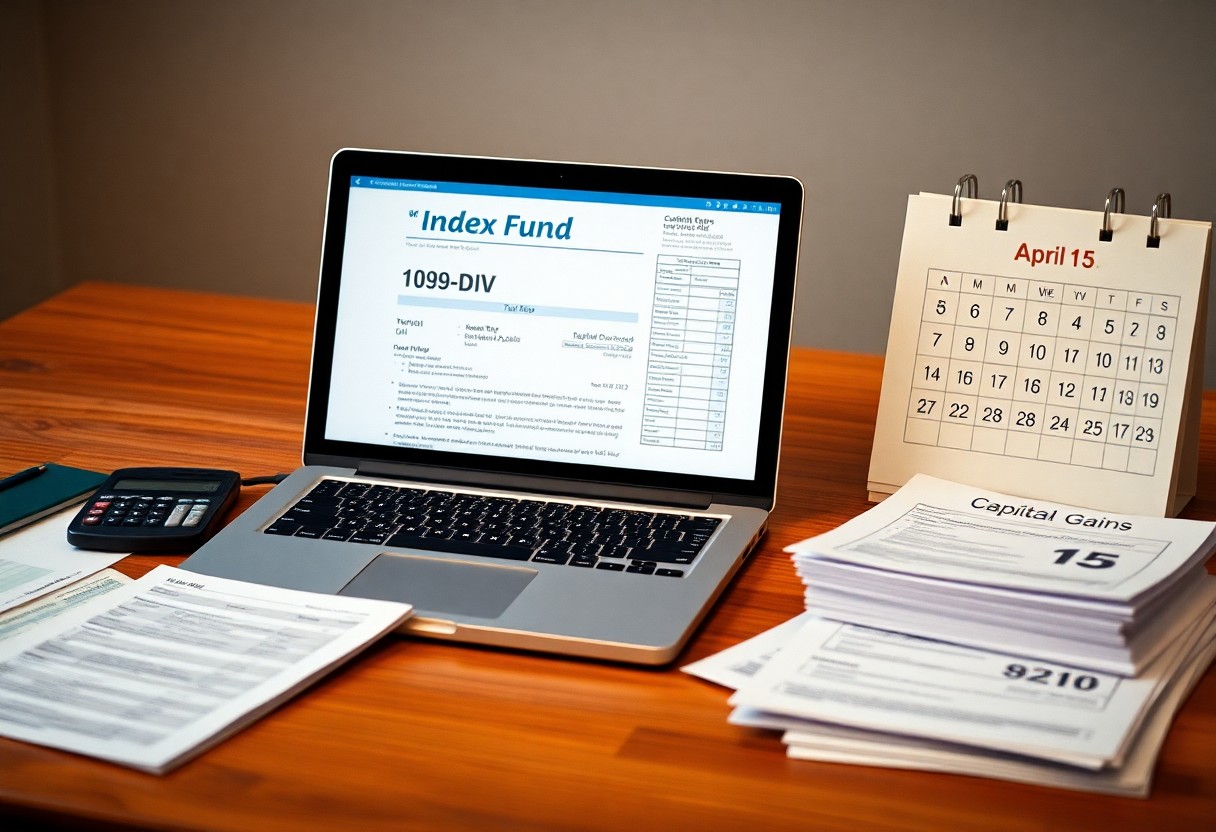
When you own index funds, taxes mainly come from dividends and realized capital gains; qualified dividends are taxed at long-term rates (0%, 15%, or 20% depending on income) while nonqualified dividends hit your ordinary rate. Because index funds typically have low turnover-often under 10%-they generate fewer taxable events than active funds, and ETFs use in‑kind redemptions to limit capital gains distributions, reducing your annual tax drag.
Understanding Capital Gains
You only pay capital gains tax when you sell shares: short-term gains (≤1 year) are taxed at ordinary income rates, while long-term gains receive preferential 0/15/20% rates. For example, a $10,000 long-term gain taxed at 15% costs $1,500. Use specific-lot cost-basis reporting and long-term holding to control realized gains and minimize taxable events when you rebalance or take withdrawals.
Tax-Advantaged Accounts
Use Roth IRAs, traditional IRAs and employer 401(k)s to shelter index-fund growth: 2024 contribution limits are $7,000 for IRAs and $23,000 for 401(k)s, so maximizing these accounts can shift tax timing. Pre-tax accounts lower your current taxable income but are taxed on withdrawal at ordinary rates; Roth accounts require after-tax contributions but offer tax-free qualified withdrawals-pick based on expected future brackets and time horizon.
Optimize asset location: hold taxable bonds and high‑yielding funds inside tax-advantaged accounts and keep broad equity index funds in taxable or Roth accounts to exploit qualified-dividend and long-term-gain treatment. Practice tax-loss harvesting-$3,000 of net capital loss can offset ordinary income per year with the remainder carried forward. If you exceed income limits for Roths, consider backdoor Roths or staged conversions to lock in tax-free growth on your index positions.
Risk Management Strategies
You should diversify across asset classes, rebalance, and use low-cost index funds to control fees and concentration risk – see How to Invest in Index Funds for fundamentals. Rebalance annually or when allocations drift more than 5 percentage points; for example, a $100,000 portfolio with a 60/40 target that drifts to 70/30 exposes you to an extra $10,000 in equity risk.
Assessing Your Risk Tolerance
You can gauge tolerance with questionnaires and simple stress tests: if a 20-30% market drop makes you sell, a lower-equity allocation (30-50%) fits; if you can stay invested through 40% declines, 70-90% equities may be appropriate. Use historical volatility-U.S. large-cap equities ~15-20% annual SD, core bonds ~3-6%-to translate feelings into allocations and run a Monte Carlo to see probable outcomes.
The Importance of Time Horizon
Your time horizon dictates how much volatility you can absorb: with 20-30 years until retirement you can lean heavily into equities to capture long-term growth, while a 3-5 year horizon calls for more cash and bonds to protect principal. Align contributions and withdrawals with the horizon to reduce sequence-of-returns risk.
For more depth, consider that sequence-of-returns risk can erase years of gains if withdrawals begin during a downturn – a 30% drop in the first five years of retirement can cut sustainable withdrawal rates by 20-25%. If you have a 10+ year horizon, historical S&P 500 data shows average annual returns near 10% with large interim swings, so a higher equity weight improves expected compound growth. Approaching goals within 3-7 years, shift gradually to laddered short-term bonds, a cash buffer equal to 1-3 years of expenses, or target-date funds that de-risk automatically to preserve capital when you need it.
Summing up
Ultimately, you build long-term wealth with index funds by choosing broad-market, low-cost funds, investing consistently through your tax-advantaged accounts, diversifying across asset classes, and staying disciplined through market cycles; you minimize fees and turnover, rebalance periodically, and focus on your long-term plan rather than trying to time the market.
FAQ
Q: What is an index fund and why is it a good choice for building long-term wealth?
A: An index fund is a pooled investment that tracks a specific market index (for example, the S&P 500, a total stock-market index, or a bond index) by holding the same or a representative sample of the securities in that index. Because index funds are passively managed, they typically have much lower expense ratios than active funds, which means more of your returns stay invested and compound over time. They offer broad diversification across companies and sectors, reduce the risk of underperformance from single-stock bets, and historically many low-cost index strategies have outperformed the average active manager after fees. For long-term wealth building, the combination of market exposure, low fees, and buy-and-hold compounding makes index funds an efficient foundation for most portfolios.
Q: How do I choose which index funds to include and how should I allocate them?
A: Start by deciding your risk tolerance and time horizon. A simple, effective approach is to pick 1-3 funds that provide broad coverage: a total U.S. stock-market index (or S&P 500), a total international-stock index, and a broad aggregate bond index if you want fixed-income exposure. Evaluate funds by expense ratio (lower is better), tracking error, tax efficiency (ETFs often more tax-efficient than mutual funds), fund size/liquidity, and provider reputation. For allocation examples: aggressive investor – 80-100% stocks / 0-20% bonds; balanced – 60% stocks / 40% bonds; conservative – 30-50% stocks / 50-70% bonds. Within stocks, a common split is 60-80% U.S. and 20-40% international, or simply use a global total-market fund. Consider a small tilt toward value or small-cap only if you understand the added volatility. Keep allocations simple, clearly documented, and aligned with your financial goals and timeline.
Q: What are the practical steps to start and maintain an index-fund strategy?
A: Fund the effort by first establishing an emergency cash buffer (3-6 months of important expenses), then open an appropriate account (taxable brokerage, traditional or Roth IRA, or an employer 401(k)). Choose your index funds and set up automatic contributions (weekly, biweekly, or monthly) to take advantage of dollar-cost averaging. Reinvest dividends and avoid frequent trading. Rebalance on a schedule (annually or semiannually) or when an asset class drifts beyond a set threshold (for example, ±5 percentage points). For tax efficiency: hold tax-inefficient assets like bonds in tax-advantaged accounts and place equity index funds in taxable accounts when appropriate; use tax-loss harvesting if you have taxable gains to offset. Monitor fees and consolidate overlapping funds to minimize expense ratios and duplicate exposures. Stay disciplined through market volatility, check your allocation at least once a year, and adjust only when your goals, timeline, or risk tolerance change.