
There’s a powerful concept called the FIRE number that can help you reach your dream of early retirement. By determining your FIRE number, you can understand how much money you need to save to become financially independent. This guide will walk you through the steps needed to calculate this important figure. For more about the FIRE movement, check out the resource on Financial Independence, Retire Early (FIRE): How It Works.

Key Takeaways:
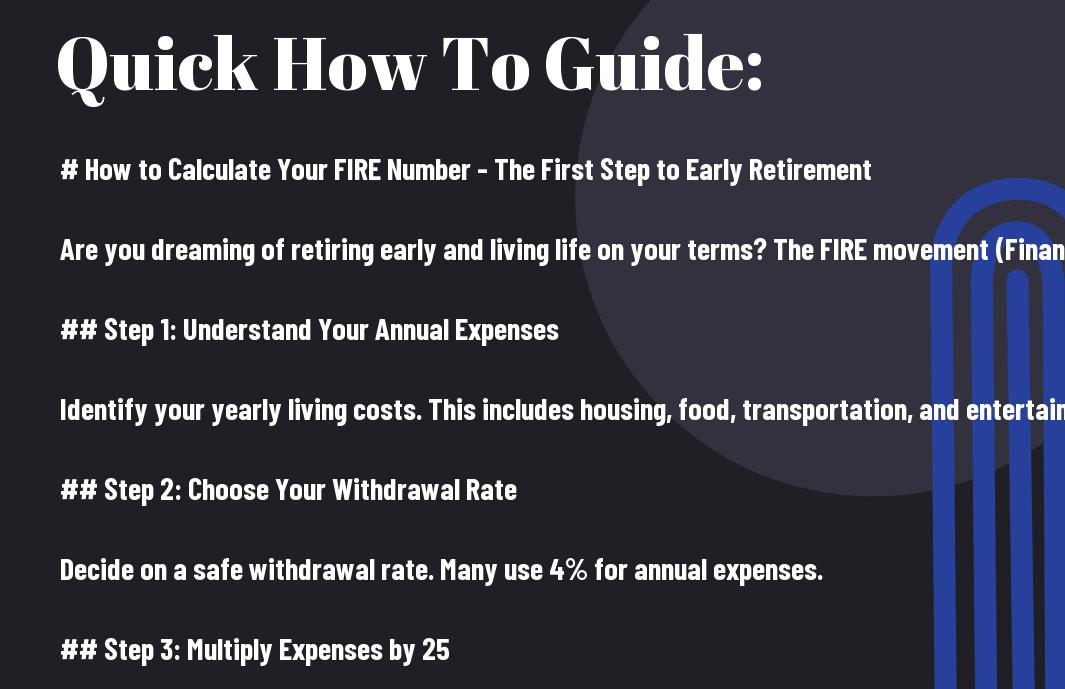
- Calculate your annual expenses: Determine how much money you need each year to maintain your lifestyle. This includes rent, food, transportation, and other necessities.
- Multiply your annual expenses by 25: This simple formula helps you find your FIRE number, which is the total amount of savings you’ll need to retire early. For example, if you spend $40,000 a year, your FIRE number is $1,000,000.
- Consider inflation and investment growth: Account for rising costs and how your money grows over time through investments. This will help you adjust your FIRE number as needed.

Understanding the FIRE Movement
For many, the FIRE movement represents the dream of retiring early and achieving financial independence. This approach emphasizes saving and investing aggressively to enable a lifestyle free from the constraints of traditional work. You may find yourself drawn to this idea, as it encourages intentional living and financial discipline.
What is FIRE?
On the surface, FIRE stands for Financial Independence, Retire Early. It advocates for setting ambitious savings goals to build a nest egg that allows you to live comfortably without working full-time. By prioritizing saving now, you can secure your freedom to travel, pursue hobbies, or spend time with family later.
Types of FIRE
On your journey to FIRE, you’ll encounter different approaches to help you reach your goals. Here are some key types:
| Type | Description |
|---|---|
| Lean FIRE | Living on a minimal budget while being financially independent. |
| Fat FIRE | Retiring early with a more luxurious lifestyle and higher spending. |
| Barista FIRE | Part-time work to supplement income while enjoying early retirement. |
| Coast FIRE | Having enough saved so that your investments can grow without additional contributions. |
| Regular FIRE | A standard approach combining a traditional retirement plan with some early retirement savings. |
. Recognizing the type of FIRE you want can help you plan effectively and set realistic goals.
To dig deeper into the types of FIRE, think about how each can fit into your life. You may prefer Lean FIRE for its simplicity or Fat FIRE for luxury. It’s also possible to choose a combination that works for you:
- Establish your budget: Knowing your expenses helps in deciding which type of FIRE suits you.
- Evaluate your savings: Take stock of how much you can save each month.
- Consider your lifestyle goals: What do you want your retirement to look like?
- Research investment options: Different paths may require varying investment strategies.
- Write your plan: Documenting your goals and methods can keep you accountable.
. Recognizing these factors will enhance your financial journey and guide you towards your FIRE number.
What is a FIRE Number?
While many people dream of retiring early, understanding your FIRE number is the first step to making that dream a reality. The FIRE number represents the amount of money you need to save and invest to retire comfortably and live off your investments. It ensures that your savings will last throughout your retirement without running out.
Definition of FIRE Number
One way to define your FIRE number is by calculating your total annual expenses multiplied by 25. This formula comes from the “25x rule,” which is based on the assumption that you can withdraw 4% of your savings each year. For example, if you need $40,000 a year, your FIRE number would be $1,000,000.
Importance of Knowing Your FIRE Number
Importance of knowing your FIRE number cannot be overstated. It gives you a clear target for savings and investments, helping you plan effectively for your future. By knowing this number, you can set specific goals and track your progress towards financial independence.
Knowing your FIRE number helps you make informed financial decisions. It allows you to budget better and prioritize your spending and saving. With a clear figure in mind, you can adjust your lifestyle and investment strategies to reach your objectives faster. Ultimately, calculating your FIRE number puts you in control of your financial future, making early retirement more achievable.
How to Calculate Your FIRE Number
After you decide to pursue Financial Independence, Retire Early (FIRE), calculating your FIRE number is your first step. Your FIRE number is the total amount of money you need to have saved to afford early retirement. It helps you understand your financial goals and plan how much to save each month. This number is unique to you, based on your lifestyle and future plans. Knowing it can motivate you to stick to your savings strategy and reach retirement sooner.
The 25x Rule
With the 25x rule, you can quickly estimate your FIRE number. This rule suggests that you should save 25 times your expected annual expenses. For example, if you plan to spend $40,000 a year, your FIRE number would be $1 million. This method provides a simple formula that helps you set a clear savings goal for your early retirement.
Customizing Your Calculation
You can customize your calculation to fit your unique situation. While the 25x rule is helpful, everyone has different needs and expenses. Consider factors like your lifestyle, where you live, and any planned large purchases. Tailoring your FIRE number gives you a more accurate target to aim for.
The more accurately you customize your FIRE number, the easier it will be to create a savings plan. Think about upcoming costs like healthcare, travel plans, and hobbies. Adjust your anticipated expenses based on these factors. Having a well-thought-out FIRE number will help you stay focused on achieving your early retirement goals.
Key Factors to Consider
Unlike many financial plans that might only focus on income, calculating your FIRE number requires a look at various key factors. These elements will help shape your financial goals and how much you need to save. Here are some of the factors you should think about:
- Your monthly expenses
- Expected retirement duration
- Your expected investment returns
- Inflation rates
Perceiving these factors as interconnected will make the calculation easier and provide a clearer path to your early retirement goals.
Monthly Expenses
Assuming you know your current monthly expenses is vital for calculating your FIRE number. This includes everything from housing costs to everyday spending. By understanding your spending habits, you can project how much you will need in retirement.
Expected Retirement Duration
Factors influencing your expected retirement duration include your current age, health, and lifestyle choices. Understanding how long you might be retired helps you plan your finances accordingly.
Expected retirement duration can significantly affect your savings goal. For instance, if you plan to retire at 40 and expect to live until 90, that’s 50 years of retirement. This long duration means you’ll need more savings to maintain your lifestyle. Consider your health and family history when estimating how long your retirement might last. Doing so ensures you don’t run out of money in your later years.
Tips for Saving Towards Your FIRE Number
All successful savers have strategies that help them reach their FIRE number. Here are some tips to fast-track your savings:
- Create a savings plan that works for you.
- Cut unnecessary expenses to boost your savings.
- Use high-interest savings accounts to earn more.
- Automate your savings to stay consistent.
This approach can help you effectively build your wealth over time.
Budgeting Strategies
You need a solid budgeting strategy to reach your FIRE number. Start by tracking your income and expenses. Use apps or spreadsheets to see where your money goes each month. Identify areas where you can cut back. Set clear financial goals and stick to your budget. The more disciplined you are, the faster you will reach your goal.
Increasing Your Income
Clearly, increasing your income can help you save more towards your FIRE number. Look for part-time work or freelance opportunities that match your skills. Consider selling items you no longer need or starting a side business based on your hobbies. Every dollar earned can significantly boost your savings.
Increasing your income opens up more financial possibilities. You might explore online courses to improve your skills or switch to a higher-paying job. Networking can also lead to new opportunities in your field, helping you raise your salary. Diversifying your income sources decreases reliance on a single job. More income means more money to save and invest towards your FIRE number.

Adjusting Your FIRE Number Over Time
Now that you have your FIRE number, it’s vital to adjust it over time. Your financial needs and goals may change as you grow older. Life events such as marriage, children, or career shifts can impact your plans. Regularly revisiting and recalculating your FIRE number ensures you stay on track. For more guidance, check out this resource on How To Calculate Your FIRE Number.
Inflation Considerations
Any growth in prices due to inflation can affect your FIRE number. As costs increase, your savings may not stretch as far as you think. To combat this, factor in an average inflation rate, typically around 3%. Adjusting your calculations ensures you have enough to maintain your desired lifestyle when you retire early.
Lifestyle Changes
An important part of recalculating your FIRE number involves lifestyle changes. Your habits, desires, and goals can shift over time, impacting your expenses. For example, if you decide to travel more or take up new hobbies, your spending may increase. It’s wise to account for these potential lifestyle changes in your financial planning.
Number one, when considering your lifestyle, think about your long-term goals. Do you want to downsize, travel, or invest in hobbies? Each of these choices may require adjustments to your FIRE number. Keep a close eye on your spending and savings habits as life evolves. This proactive approach will help ensure your FIRE number continues to align with your dreams and financial goals.
Summing up
As a reminder, calculating your FIRE number is an necessary step towards your goal of early retirement. By figuring out how much money you need to save and invest, you can create a clear plan for your financial future. This journey may require discipline and commitment, but the benefits are worth it. To learn more about the steps involved, check out these Six steps to achieve financial independence and retire …. Start taking control of your finances today!
FAQ: How to Calculate Your FIRE Number – The First Step to Early Retirement
Q: What is a FIRE number?
A: Your FIRE number is the amount of money you need to save and invest to achieve Financial Independence, Retire Early (FIRE). It represents the total savings needed to live comfortably without working, usually calculated as 25 times your expected annual expenses.
Q: How do I calculate my annual expenses for the FIRE number?
A: To find your annual expenses, track all your spending for a month or more. Include vitals like housing, food, transportation, and healthcare. Don’t forget non-vitals like entertainment or dining out. Add these costs to get a total yearly figure. This helps create an accurate picture of what you need to live on each year.
Q: Why is the 25 times rule used for calculating the FIRE number?
A: The 25 times rule is based on the 4% rule. This rule suggests that if you withdraw 4% of your retirement savings each year, your money will last for 30 years. By multiplying your expected yearly expenses by 25, you find a safe amount to save to support your lifestyle during retirement.
Q: What should I do once I have my FIRE number?
A: Once you have your FIRE number, create a plan to reach it. You can do this by saving more or investing wisely. Review your budget to see where you can cut costs and increase savings. Consider investments like stocks, bonds, or real estate that can help grow your money over time.
Q: Is the FIRE number the same for everyone?
A: No, the FIRE number varies for each person. It depends on individual lifestyle choices, expenses, and financial goals. Factors include your location, family size, and how you plan to spend your retirement. Adjust your calculations to fit your unique situation to set a realistic FIRE number.
Key Takeaways
– Your FIRE number is vital for planning early retirement.
– Calculate your annual expenses by tracking all spending.
– Use the 25 times rule to determine your savings goal.
– Create a strategy to save and invest to reach your FIRE number.
– Customize your FIRE number based on your personal lifestyle and financial goals.
By understanding and calculating your FIRE number, you take the first step toward a future of financial freedom. Start planning today for a brighter tomorrow!