Many aspiring homeowners can build a solid down payment in three years by setting a clear target, creating a strict budget, automating savings, cutting discretionary spending, increasing income, and choosing a low-risk savings vehicle; you should calculate the exact monthly amount, funnel windfalls into the fund, track progress monthly, and adjust expenses to stay on course so you reach your goal without derailing your financial stability.

Key Takeaways:
- Set a clear target and timeline: calculate the down payment (e.g., 20% of your target price or lender minimum) plus closing costs, subtract current savings, then divide the remainder by 36 to get a monthly savings goal.
- Boost your monthly savings rate: build a tight budget, cut nonimperative spending, pursue side income, and automate transfers into a separate high-yield savings account or short-term, low-risk instruments.
- Protect and accelerate progress: keep an emergency fund separate, apply windfalls (bonuses, tax refunds) to the goal, track progress monthly, and avoid high-risk investments as the purchase date approaches.
Assessing Your Financial Situation
Inventory your assets and liabilities, then set a realistic target: for a $350,000 home a 20% down payment equals $70,000-about $1,944 monthly over three years. Factor in closing costs (2-5% of purchase price) and an emergency buffer, and you’ll see how aggressive your savings rate must be.
Evaluating Income and Expenses
Track every income source and recurring expense for two months to establish your baseline. If your net pay is $3,500/month and rent is $1,200, groceries $400 and transportation $300, you’d have $1,600 remaining-identify $900 to $1,100 you can reallocate to a dedicated down-payment account to hit aggressive targets.
Understanding Credit Scores
Check your FICO range (300-850) because a score over 740 typically unlocks the lowest mortgage rates while scores near 620 can limit options and raise costs. You’ll want to know how collection accounts, late payments and high balances are currently weighing on your profile before you lock in a loan strategy.
Pull credit reports at AnnualCreditReport.com and dispute errors that lower your score; correct addresses and duplicate collections are common. Reduce revolving utilization below 30%-ideally under 10%-and avoid new hard inquiries in the 12 months before applying. Consistent on-time payments for 12-24 months significantly improves mortgage pricing.
Setting a Savings Goal
You should anchor your goal to a target purchase price and loan type so your plan is specific-on a $350,000 home, 20% equals $70,000. Use HOW TO SAVE FOR YOUR HOUSE DOWN PAYMENT IN 5 YEARS OR LESS to compare timelines and tactics, then break the total into monthly milestones and review them monthly to adjust contributions as income or expenses change.
Determining the Down Payment Amount
You pick a loan type then translate percentages into dollars: conventional loans commonly use 20% to avoid PMI, FHA requires about 3.5%, and VA/USDA can be 0% for eligible buyers. For a $300,000 purchase that’s $60,000 (20%) or $10,500 (FHA); add estimated closing costs (2-5% of price) and any immediate repairs to the total so your target covers all upfront needs.
Creating a Timeline for Savings
Divide your total target by 36 months for a three-year plan-$60,000 becomes about $1,667 per month. If that exceeds a comfortable share of your net income, adjust by lowering your down payment percentage, stretching the timeline, or planning regular supplemental contributions from bonuses and tax refunds to keep the monthly goal feasible.
Automate transfers to a high-yield savings or short-term CD and split contributions by paycheck to smooth cash flow; for example, saving $1,667/month can be achieved with two $833 transfers per month. Increase contributions when you get raises, funnel 50-100% of bonuses to the fund, and cut discretionary spend by small percentages-2-5% reallocations compound quickly over 36 months while you keep a 3-month emergency fund separate.
Developing a Budgeting Plan
Translate your down payment goal into a monthly target – for example, a 20% down payment on a $300,000 home is $60,000, so you’d need $1,667/month over 36 months – then treat that amount as a non-negotiable bill. Track expenses, automate transfers to a separate savings account, and trim categories until the monthly figure fits; use How to Save for a House: A Step-by-Step Guide for tactical steps.
Identifying Areas to Cut Costs
Audit recurring charges first: subscriptions, cable, premium apps and unused memberships. Cut dining out and limit rideshares, renegotiate insurance and phone plans, and compare grocery budgets – freeing $200/month by trimming these can add $2,400/year, or $7,200 in three years toward your down payment. Reallocate savings from high-interest debt payoff once balances fall.
Allocating Extra Funds for Savings
When you receive bonuses, tax refunds, or one-off cash, route them straight to your down payment account. A $5,000 bonus reduces a $1,667/month target by about $139/month over 36 months, letting you either lower monthly contributions or reach the goal faster; automate these deposits so windfalls don’t get spent.
Allocate fixed shares of extra income – for example, 100% of bonuses and 50% of raises – into a dedicated high-yield savings or short-term CD so your money earns interest without principal risk; diverting $3,000 of a raise cuts your 36-month monthly need by roughly $83. Use cashback from cards and side-gig revenue the same way, and set rules (like all tax refunds) to maintain consistency.
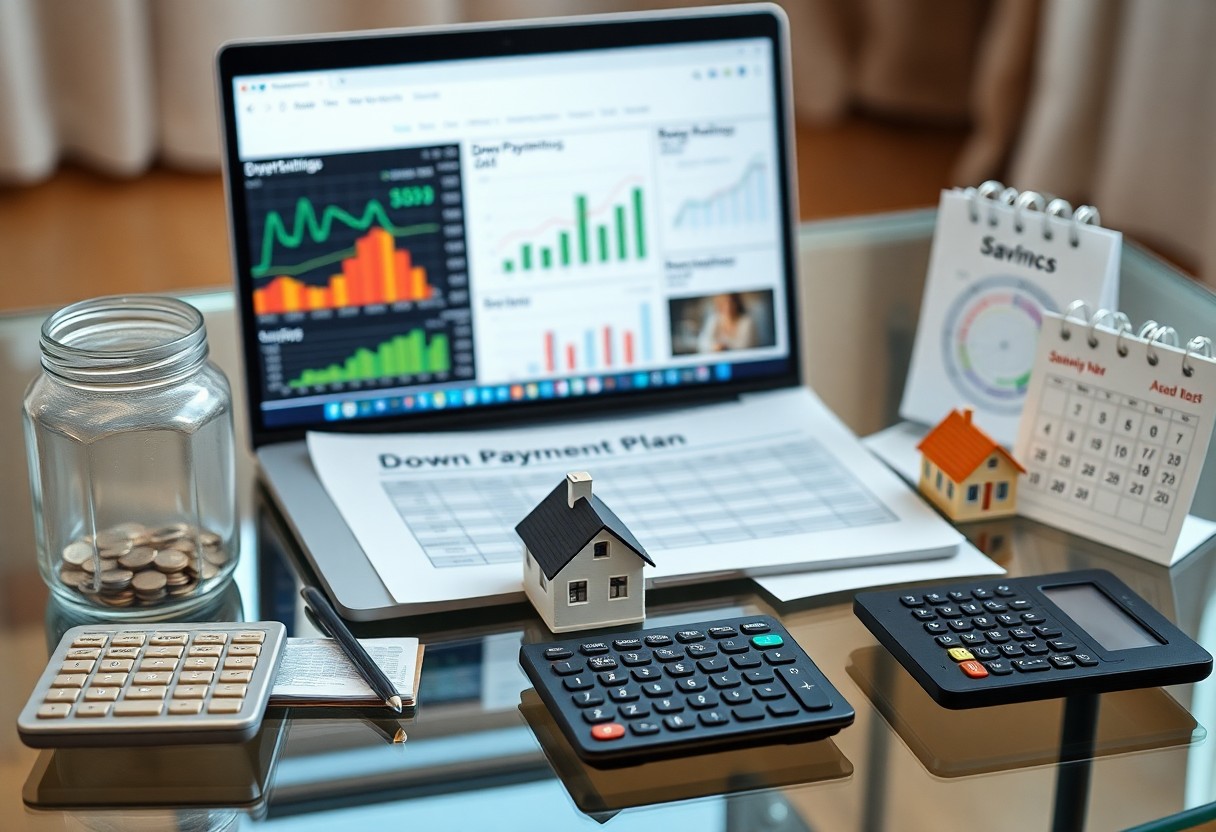
Exploring Savings Accounts and Investment Options
To boost your down payment, balance liquid safety with modest returns: high-yield savings or online accounts at 3-5% APY for emergency access, short-term CDs locked for higher yields, and conservative short-term bond funds or T-bills for slightly better returns. For example, $10,000 at 4% APY grows to about $11,249 in three years, trimming how much you must save monthly. Match each dollar to the role you give it-liquidity, growth, or principal protection.
High-Interest Savings Accounts
Online high-yield savings accounts often pay 3-5% APY and are FDIC-insured up to $250,000, so you preserve principal while earning meaningful interest. If you park $20,000 at 4% APY, you’ll have roughly $22,497 after three years-accessible instantly for inspections or fees. Use automatic transfers from checking to enforce discipline and compare rate guarantees and monthly limits before committing.
Short-Term Investments
Short-term investments include Treasury bills, 6-36 month CDs, and short-duration bond funds; they typically yield more than savings but come with varying liquidity and price risk. Treasury bills are backed by the U.S. government and can be held to maturity for predictable returns, while short-term bond funds may average 2-4% annual returns with modest volatility. Choose based on how soon you’ll need the funds and your risk tolerance.
To deepen returns without overexposing yourself, ladder CDs across 6, 12 and 24 months so portions mature regularly, or use TreasuryDirect to buy T-bills with maturities from 4 to 52 weeks for predictable yields and state-tax exemption on interest. Be mindful of early withdrawal penalties on CDs and bid-ask spreads on bond funds; if you need the money within three years, favor instruments with stated maturities or easy sale options to avoid principal losses.

Tips for Boosting Your Savings
Automate transfers so $500 monthly into a 2% APY high-yield account grows to roughly $18,300 in three years through compounding. Trim subscriptions and redirect $50-$150 monthly; $100 saved equals $3,600 toward your down payment over 36 months. Use a cash-back card for importants (1-2% back) and move rewards to savings. Any small, consistent change compounds into meaningful progress.
- Set automatic monthly transfers to a high-yield account
- Pause or cancel unused subscriptions and redirect savings
- Use cash-back/cards and sweep rewards to your fund
- Allocate bonuses/overtime directly to your down-payment account
Utilizing Employer Benefits
If your employer offers a 401(k) match, contribute enough to capture it-that match is effectively an immediate 100% return on those dollars. You can tap a 401(k) loan for up to $50,000 or 50% of your vested balance to bridge a down payment, but factor lost market growth and repayment terms. Scan for employer housing assistance or relocation grants (often $2,000-$10,000) and use payroll-split tools to route raises or bonuses straight into your savings.
Generating Extra Income
Choose side work that fits your schedule: driving at $20/hour for 5 hours weekly nets about $5,200 a year, renting a spare room at $50/night three nights monthly adds $1,800 annually, and freelancing can bring $300-$1,000+ per month depending on rates. Direct all extra income into your down-payment account and automate deposits so you don’t spend windfalls.
Set a concrete goal-if you target $400/month extra, you’ll add $14,400 in three years; to net $400 after ~20% taxes/fees you must earn about $500/month gross. Track effective hourly rates: at $25/hour you need 20 billable hours monthly to meet that gross. Prioritize higher-margin gigs, batch tasks to improve hourly output, and funnel raises, bonuses, and tax refunds straight into the fund to shorten your timeline.

Staying Motivated and On Track
Keep motivation high by turning goals into visible, bite‑sized wins: automate $833 monthly into a high‑yield savings account for a $30,000 down payment in 36 months, chart progress with a savings thermometer, and schedule small rewards when you hit each 10% increment. When income changes, recalibrate contributions and cut a discretionary subscription or two to stay on pace.
Setting Milestones
Break the total into timed checkpoints: set monthly targets (e.g., $833/month for $30,000 in 36 months), quarterly goals ($2,500 every three months), and a one‑year balance goal like $10,000. Use deadlines and specific amounts so you can spot shortfalls early. When you meet a milestone, adjust future targets or increase savings rate by 5-10% to accelerate progress.
Tracking Progress Regularly
Track balances weekly and run a monthly reconciliation: log starting balance, deposits, interest earned, withdrawals, and ending balance. Use an app or simple spreadsheet with a running formula so you see compound interest and contribution trends. If you fall behind by $500, split the gap over the next 6-12 months to keep momentum without derailing your budget.
Create spreadsheet columns for date, starting balance, contribution, interest, fees, and ending balance; add a checkbox for automated transfers. Review summaries on the first of each month and compare to your milestone schedule; for example, if interest on a HYSA is 2% APR, include projected interest so you don’t overestimate self‑funding. When a bonus or tax refund arrives, route 50% straight to savings to shorten the timeline.
Final Words
To wrap up, you can reach a down payment in three years by setting a clear target, breaking it into monthly goals, automating transfers into a high-yield account, trimming discretionary spending, and boosting income where possible. Track progress monthly, adjust your plan for windfalls or setbacks, and stay disciplined so your savings grow steadily toward homeownership.
FAQ
Q: How do I calculate a realistic down payment target and monthly savings goal?
A: Decide the target home price and down payment percentage (examples: 3.5% for FHA, 5-20% typical for conventional). Add estimated closing costs and a separate emergency buffer. Formula: (Target down payment + closing costs + buffer − existing savings) ÷ 36 = monthly savings needed. Example: $300,000 home, 10% down = $30,000; closing costs $6,000; buffer $4,000; current savings $2,000 → (30,000+6,000+4,000−2,000)=38,000 → 38,000/36 ≈ $1,056/month. Recalculate if your house price or down payment percentage changes and build a small contingency for interest/fees.
Q: Which savings vehicles are best for a 3-year time frame?
A: Prioritize safety and liquidity. Use a high-yield online savings account or money market for easy access and FDIC insurance. Consider laddered short-term CDs or Treasury bills/notes for slightly higher yields while keeping maturity within 3 years. Short‑term bond funds add yield but carry price risk if sold early, so use cautiously. Avoid heavy stock exposure for the core down payment fund due to market volatility. Keep the goal account separate from your emergency fund to avoid accidental withdrawals.
Q: What practical strategies will help me reach the goal within three years?
A: Automate transfers to your goal account right after payday; treat the transfer like a nonnegotiable bill. Trim recurring expenses (streaming, subscriptions, insurance shopping), reduce variable costs (meal prep, transport), and redirect savings into the down payment fund. Increase income with side gigs, overtime, or selling unused items and funnel one‑time windfalls (tax refunds, bonuses, gifts) to the fund. Negotiate bills, use cash‑back or bonus rewards strategically, and track progress monthly with a spreadsheet or app to stay on target. Explore down payment assistance, grants, or acceptable gift funds if eligible, but verify program rules early.